- Published on
Securing Agentic AI: Maturity Model
The transition from AI pilots to production-grade agentic systems is happening faster than most security frameworks can keep up with. Recently, an expert-led breakdown on "IAM for AI" caught our attention, perfectly summarizing the journey every enterprise must take to secure autonomous agents.
The core message? To move from chaos to control, organizations need a clear progression that tackles four fundamental risks: accountability, privilege, abuse, and data safety.
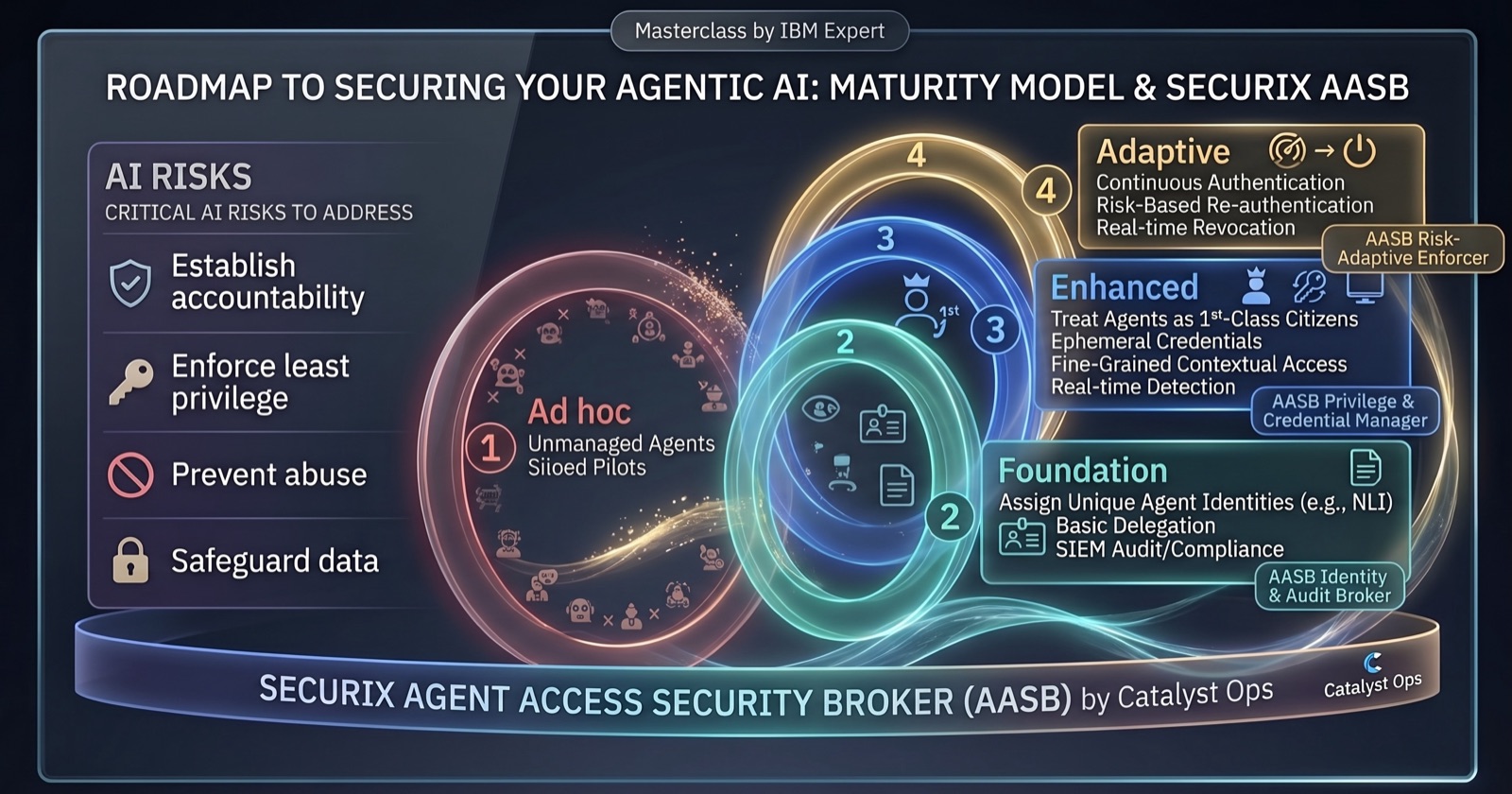
Here is the 4-step roadmap to maturing your Agentic AI security posture.
🚀 Step 1: Ad Hoc (The Wild West)
This is where most organizations start. AI agents are often deployed as siloed pilots with unmanaged identities.
- The Reality: Developers use personal API keys or long-lived service accounts.
- The Risk: Zero visibility into what agents are doing, overlapping permissions, and a high risk of credential leakage.
- The Outcome: A recipe for a security disaster.
✅ Step 2: Foundation (The Starting Point)
The shift begins here, moving from "hidden" agents to managed entities. The focus is on basic visibility and control.
- Non-Human Identities (NHI): Assigning clear, unique IDs to agents rather than sharing human credentials.
- Basic Delegation: Implementing basic permission delegation frameworks.
- Auditability: Ensuring all agent activities are logged in a SIEM for compliance and forensic analysis.
📈 Step 3: Enhanced (The Mature IAM)
At this stage, identity management for AI catches up to human-level security standards. Agents are treated as 1st-class citizens.
- Dynamic Credentials: Moving away from static keys to short-lived, ephemeral credentials.
- Fine-Grained Context: Access is no longer binary; it’s based on specific context and granular permissions.
- Real-Time Detection: Moving from "log and look later" to real-time threat detection for agent behavior.
🛡️ Step 4: Adaptive (The Futureproof Goal)
The ultimate state of security. This is where identity checks become continuous rather than point-in-time.
- Continuous Authentication: Ongoing validation of agent intent and risk.
- Risk-Based Escalation: Dynamically escalating authentication checks if an agent’s behavior deviates from its baseline.
- Automated Response: The ability to automatically revoke access in real-time the moment a risk threshold is met.
🛠️ How SecuriX Enables the Journey
At Catalyst Ops, we built SecuriX (our Agent Access Security Broker - AASB) specifically to be the engine that drives this progression. We don't just provide a dashboard; we provide the enforcement point that helps you move from "Foundation" to "Adaptive" seamlessly.
With SecuriX, you can:
- Elevate Agents: Manage every agent as a first-class identity with its own lifecycle.
- Automate Privileges: Implement fine-grained, dynamic access controls that evolve with your agents.
- Go Ephemeral: Issue and manage short-lived credentials at scale without developer overhead.
- Enable Continuous Auth: Monitor agent risks in real-time and trigger risk-based re-authentication or instant revocation.
🎥 A Recommended Watch
If you are moving your AI from concept to product, we highly recommend watching the original masterclass by IBM experts that inspired this model: IAM for AI: 4 Steps to Secure and Futureproof Agentic Systems.
🚀 Call for Design Partners
We are currently opening our doors to a select group of early Design Partners.
If you are actively building autonomous AI agents and want to offload your security and access management, we want to work with you. You will get:
- Early access to our SDK and Portals.
- White-glove onboarding.
- The ability to directly shape our product roadmap.
Interested in being part of our first cohort? Reach out to us or send us a DM, and we’ll get you set up.
This post is part of SecuriX's mission to make enterprise AI secure, compliant, and trustworthy.
See SecuriX in front of your own traffic.
Tell us where to reach you and we'll set up a walkthrough with your identity provider, your policies, and your budget structure.