- Published on
IAM vs. AASB
Introduction: The Paradigm Shift
The core premise: Security infrastructure has not evolved as fast as orchestration frameworks (like LangChain/LangGraph).
The trap: Developers are trying to shoehorn autonomous AI agents into legacy IAM and Role-Based Access Control (RBAC) models.
The thesis: Treating an AI agent like a human user with a static token is an architectural flaw. Agents require a fundamentally different trust layer—an Agent Access Security Broker (AASB).
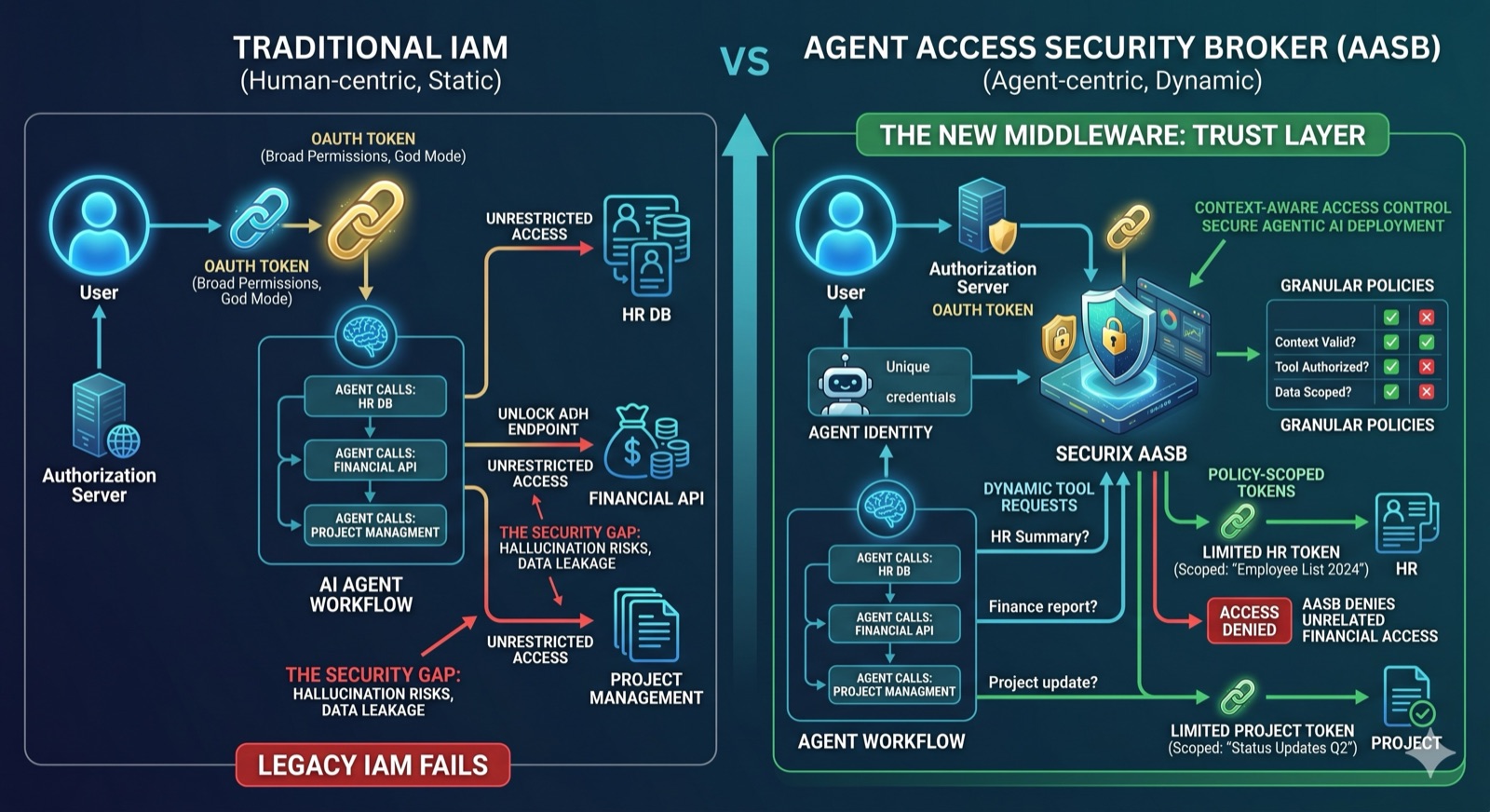
1. The "God Mode" Problem (OAuth’s Blind Spot)
The Argument: OAuth was designed for delegated human authorization, not autonomous task execution.
The Details: When an agent uses a standard OAuth token to connect to an enterprise database or SaaS app, the destination service cannot distinguish between a human clicking "export" and a hallucinating LLM deciding to delete records. The token grants broad, unrestricted access based on the user's identity, completely ignoring the agent's intent.
The AASB Solution: An AASB sits between the orchestration layer and the data, terminating the broad token and issuing strict, limited-scope permissions scoped exactly to the specific task the agent is trying to accomplish.
2. Static RBAC vs. Dynamic Context
The Argument: Roles are static; Agent workflows are highly dynamic.
The Details: Standard IAM assigns access based on a static org chart (e.g., "Manager" gets read/write access to HR docs). But what if a Manager asks an AI agent to summarize a meeting, and the agent decides it needs to read all HR docs to do so? RBAC allows it because the role permits it, even though the context doesn't require it.
The AASB Solution: AASBs introduce dynamic, policy-driven guardrails. It evaluates not just "who is asking," but "what is the agent trying to do right now, and does this specific tool call violate the developer's security policy?"
3. The Auditability Void and Forensics
The Argument: Standard IAM logs are useless for debugging autonomous behavior.
The Details: If an enterprise system goes down or data is leaked, a standard IAM audit log will just show: User_Token_Authenticated at 10:04 AM. It will not show the prompt, the chain of thought, or why the agent initiated the API call. For developers pushing to production, this lack of forensic visibility is a massive compliance blocker.
The AASB Solution: A dedicated broker logs the entire lifecycle of the agent's action. It logs the intent, the policy evaluation, the specific tool called, and the data returned. It provides an undeniable cryptographic ledger of machine behavior.
Conclusion: The New Middleware
Traditional IAM isn't dead; it just handles authentication (who the human is). But authorization (what the agent is allowed to do) must be handled by an AASB.
The Call to Action: For engineering teams building multi-agent systems, relying on legacy IAM is a massive liability. Integrating an AASB at the infrastructure level is the only way to ship autonomous workflows to production without compromising enterprise security.
See SecuriX in front of your own traffic.
Tell us where to reach you and we'll set up a walkthrough with your identity provider, your policies, and your budget structure.