WebMCP: Shaping the Future of the Agentic Web
An in-depth look at WebMCP and Google Chrome Labs' webmcp-tools repository, accelerating the transition to a standardized, agent-friendly web.
As artificial intelligence becomes increasingly integrated into our daily workflows, the way AI agents interact with the web is evolving. Historically, AI relied on brittle and unreliable web scraping to read pages or execute actions. Enter WebMCP—a standardized approach designed to let web applications seamlessly and securely expose their capabilities directly to AI agents.
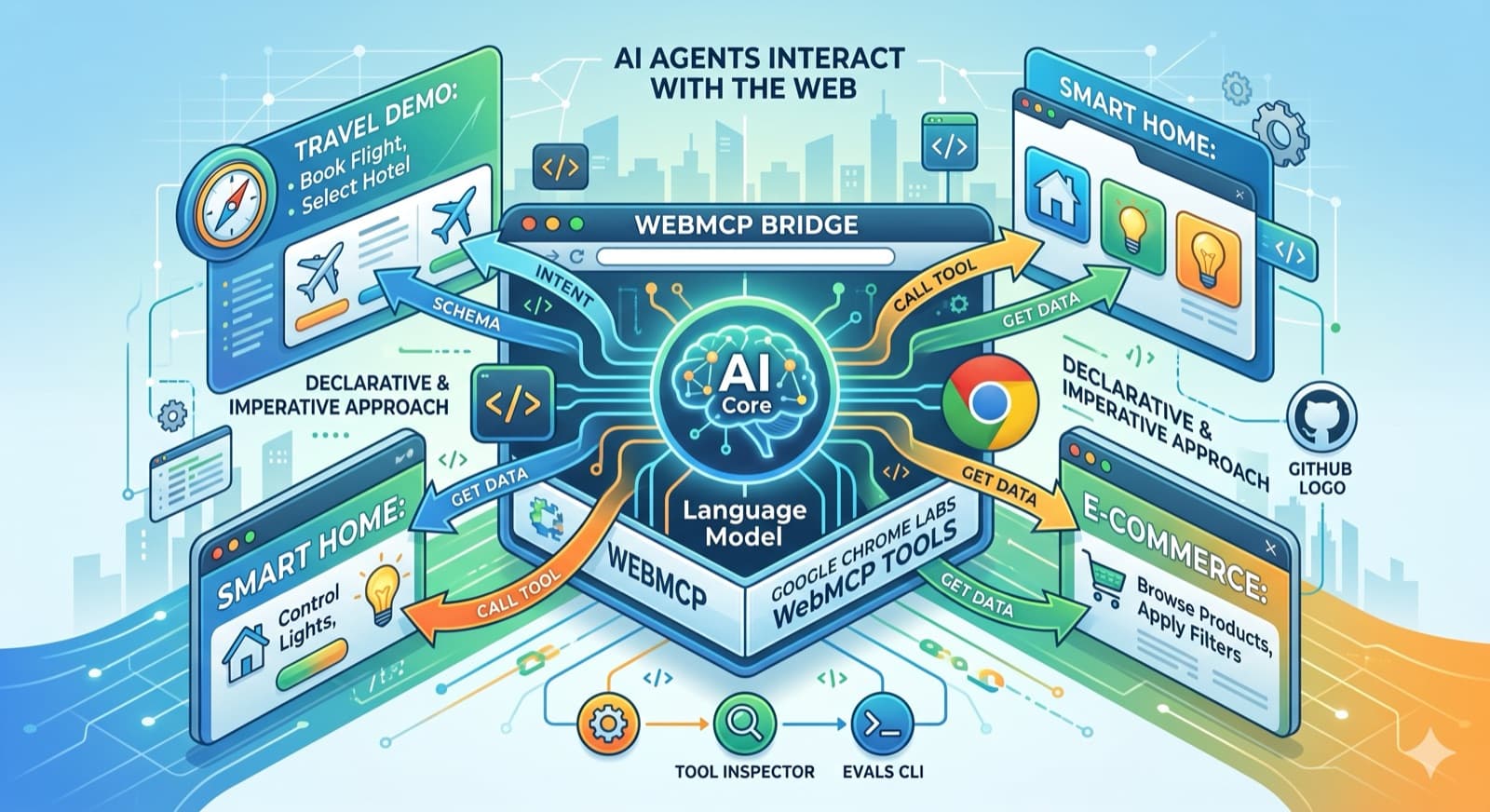
Recently, Google Chrome Labs released the webmcp-tools repository, a comprehensive suite of developer utilities and interactive demos built to accelerate the adoption of the WebMCP API. Here is a deep dive into what this toolkit offers and how it paves the way for a more "agentic" web.
What is WebMCP?
At its core, WebMCP provides a standardized interface allowing a web page to declare structured tools to an AI agent or an automation layer. Instead of an AI guessing how to navigate a DOM or parsing raw HTML, WebMCP allows the application to explicitly say: "Here is a function to search for flights, here is the required data schema, and here is how to execute it." This enables AI models to programmatically and reliably interact with user interfaces—such as applying filters, reading results, and submitting forms—using both declarative and imperative approaches.
Essential Developer Utilities
The webmcp-tools repository provides two core utilities to help developers build, test, and debug WebMCP integrations:
1. WebMCP Model Context Tool Inspector
Debugging invisible interactions between an AI agent and a webpage can be incredibly difficult. To solve this, Google Chrome Labs provides a dedicated Chrome Extension. The Tool Inspector empowers web developers to:
- Verify if WebMCP tools are being correctly exposed by the webpage.
- Visualize the exact input schemas expected by the tools.
- Debug connection and execution issues directly within the browser's developer tools environment.
2. WebMCP Evals CLI
Building reliable AI agents requires robust testing. The WebMCP Evals CLI is a command-line tool specifically built to evaluate the tool-calling capabilities of Large Language Models (LLMs). Developers can define specific test cases and schemas to automatically verify if an interactive AI agent is correctly understanding user inputs and calling the appropriate web tools in response.
Showcasing the Potential: The Demos
To bridge the gap between theory and practice, the repository includes an extensive library of high-fidelity demos. These applications showcase how WebMCP can transform standard web interfaces into AI-controllable platforms:
- Travel WebMCP & L'Atelier Hotel Chain: React-based applications demonstrating how AI can programmatically search for flights or book hotel rooms by dynamically interacting with UI filters and reading the outputted results.
- WebMCP Smart Home: A sleek, interactive dashboard where an AI agent can dynamically reconfigure home controls—like thermostats, front door cameras, and lighting—based purely on a user's natural language intents.
- E-Commerce & Retail (Luxe Leather, WebMCP Sports, The Morning Ritual): Demonstrates how WebMCP handles complex storefronts, allowing agents to navigate catalogs, analyze technical specs, manage shopping carts, and even initiate product returns on behalf of the user.
- WebMCP zaMaker! & Maze: Creative interactive experiences, including an imperative-tool demo for building a customized pizza and a maze escape game navigated entirely by prompting an AI agent without keyboard or mouse input.
The WebMCP Page Agent
Perhaps the most exciting inclusion is the WebMCP Page Agent, a Gemini-powered "meta-demo." It acts as a universal controller, allowing you to drive any WebMCP-enabled website using simple, natural language commands, proving the viability of a hands-free, AI-assisted web browsing experience.
Why This Matters for Developers
The WebMCP toolkit represents a fundamental shift in web development. By adopting these standards, developers can future-proof their applications, making them "AI-ready." Whether you are building an e-commerce platform, a booking system, or an internal dashboard, WebMCP ensures that your application can be seamlessly driven by the next generation of LLMs and autonomous agents.
Community Forum
Questions, Feedback & Discussions
Join the conversation
Recent Discussions 0 Comments
No questions yet. Be the first!