The 4 Building Blocks of AI Action (MCP Primitives)
Explore the four fundamental MCP Primitives—Resources, Tools, Prompts, and Tasks—and learn how breaking down AI behavior enables surgical security.
Welcome to Day 19 of our #30DaysOfTrust Challenge!
Back on Day 8, we talked about how the Model Context Protocol (MCP) is the "USB-C" of the AI era—a universal cable that connects AI agents to your enterprise data. Then, on Day 13, we covered the "MCP Blindspot," explaining why you can't just plug that cable in without a Zero Trust security layer.
But today, we are going to slice that USB-C cable open and look at what is actually traveling inside the wires.
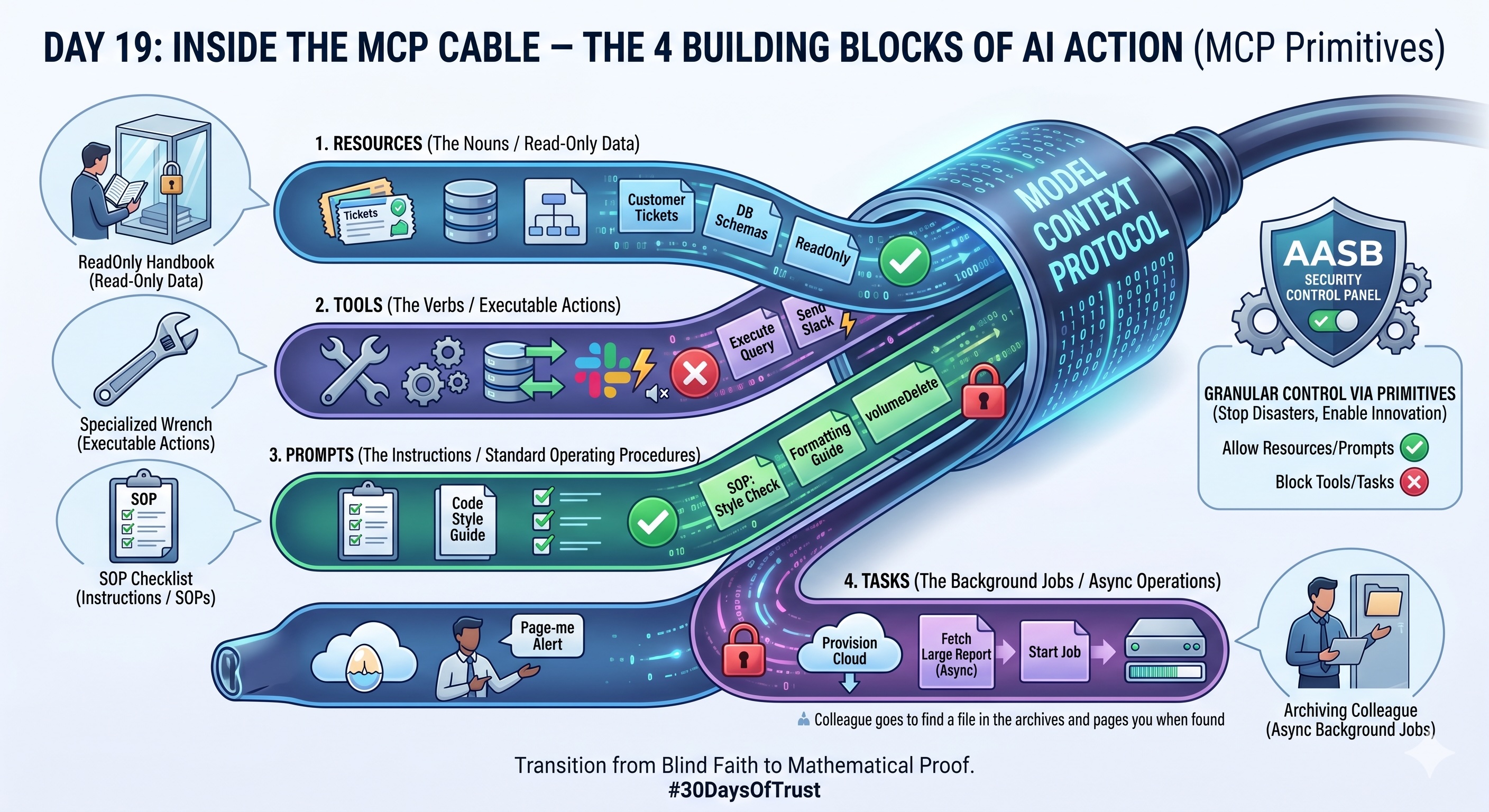
If you want to secure an AI agent, you have to understand exactly how it interacts with the world. In the MCP standard, AI agents interact using four fundamental building blocks, known as Primitives.
Think of these Primitives as the nouns, verbs, and workflows of your AI agent. Here is the layman’s breakdown:
1. Resources (The Nouns / Read-Only Data) 📚
This is how an AI agent looks at information without changing it.
- The Analogy: Imagine handing a new employee a company handbook that is locked inside a glass case. They can read it, memorize it, and use it to answer questions, but they cannot cross anything out or rewrite the pages.
- Real-World Example: An AI agent reading a customer's recent support ticket or pulling the latest database schema to understand its structure.
2. Tools (The Verbs / Executable Actions) 🛠️
This is where the AI gets its hands dirty. Tools are the functions an agent can trigger to actually change the state of the world outside its model.
- The Analogy: Giving the AI a specialized wrench. It isn't just reading anymore; it is tightening bolts, opening valves, and building things.
- Real-World Example: An AI agent executing a database query, triggering a Slack message, or (if we recall our nightmare scenario from a few days ago) executing a
volumeDeletecommand.
3. Prompts (The Instructions / Standard Operating Procedures) 📋
Sometimes users need the AI to follow a very specific, repeatable format for a task. Prompts allow servers to provide reusable instruction templates.
- The Analogy: Handing the AI a clipboard with a specific "Standard Operating Procedure" checklist that it must follow every time it handles a certain type of request.
- Real-World Example: A template that tells the AI, "Whenever a user asks for a code review, always check against our internal style guide and format the output in these three specific bullet points."
4. Tasks (The Background Jobs / Async Operations) ⏳
This is the newest and most powerful primitive. Sometimes, a job takes a long time (like compiling a massive report). Instead of holding the connection open and staring at the screen waiting, the AI can kick off a background job.
- The Analogy: Asking a colleague to go to the archives and find a file, but saying, "Don't make me wait here. Go do it, and page me when you have the results."
- Real-World Example: An AI agent instructing a system to provision a new cloud environment, allowing the user to continue chatting while the infrastructure spins up in the background.
Why Does This Matter for Security? 🎯
You cannot secure what you don't understand.
If you view MCP as just a single "on/off" pipe, security is impossible. But when you understand these four Primitives, you realize that an Agent Access Security Broker (AASB) can enforce granular control.
Through a centralized policy layer, you don't have to cut the whole USB-C cable. You can simply say: "This AI agent is allowed to use Resources to read the database, and Prompts to format its answers. But its access to Tools and Tasks is strictly disabled."
By breaking down AI behavior into Primitives, we move away from blanket blocking and toward precise, surgical security that enables innovation without the risk.
#30DaysOfTrust #MCP #AIPrimitives #AgentSecurity #AASB #AISecurity #SecuriX #BuildInPublic #AIInfrastructure
Spread the word
Deploy the Enterprise AI Gateway.
Route all company AI through SecuriX. Cut per-seat costs, audit every prompt, and block PII before it leaves your org.
Book a DemoCommunity Forum
Questions, Feedback & Discussions
Join the conversation
Recent Discussions 0 Comments
No questions yet. Be the first!