When AI Agents Team Up
Explore the world of Multi-Agent Collaboration and how to maintain security and trust when AI agents work together as a team.
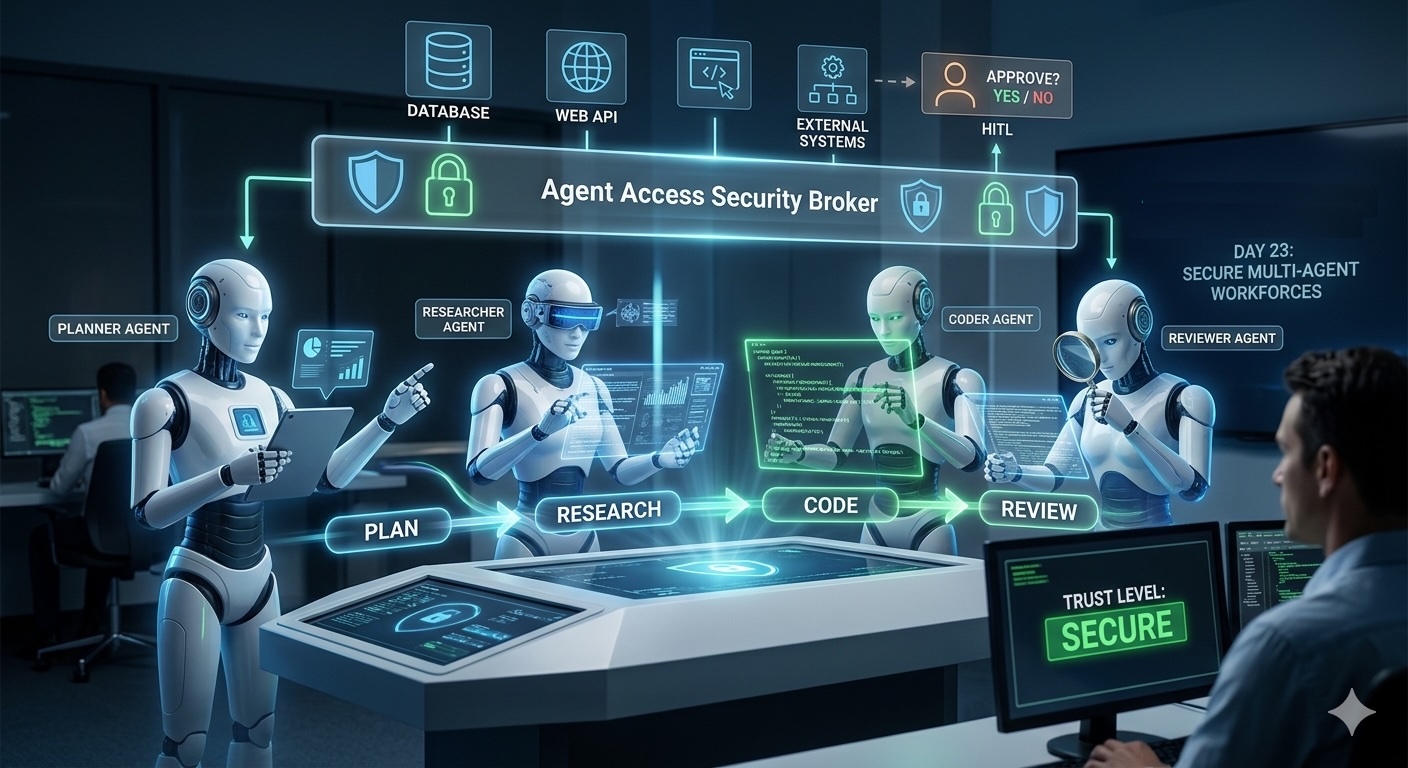
Welcome to Day 23 of our #30DaysOfTrust Challenge!
Yesterday, we looked at how individual AI agents learn and execute specific skills. Today, we are leveling up. We are looking at what happens when those agents start working together.
In the AI world, this is called Multi-Agent Collaboration. But in layman's terms? It is simply building a digital team.
The "Jack of All Trades" Problem 🃏🏚️
If you have ever tried to get a single AI chatbot to research a market, write a business plan, design a logo, and write code all in one prompt, you know it usually fails. One AI trying to do everything is like one founder trying to be the CEO, lead engineer, accountant, and marketing director all at once. Eventually, things break down.
The Multi-Agent Solution 🤝🤖
Instead of relying on one generic AI, Multi-Agent Collaboration uses a team of specialized AI agents. Think of how a human team works:
- The Planner Agent breaks down a big goal into smaller tasks.
- The Research Agent browses the web for the necessary data.
- The Coder Agent writes the software based on that research.
- The Reviewer Agent checks the code for bugs.
They pass the baton back and forth, just like a real startup squad. This is the exact philosophy behind platforms like SquadOS—giving founders a collaborative team of specialized agents rather than just a single, overworked tool.
The Trust Factor: Securing the Squad 🛡️🚧
But here is where the "Trust" in our #30DaysOfTrust comes in. When agents start talking to each other and handing off tasks, the security risks multiply.
If the Research Agent gets tricked by a bad website and passes malicious instructions to the Coder Agent, your whole system could be compromised. To make multi-agent collaboration work in an enterprise setting, we need strict boundaries:
- Agent-to-Agent Verification: Agents must verify who they are receiving instructions from.
- Strict Access Control: The Research Agent shouldn't have the password to your database, and the Coder Agent shouldn't have access to your personal email.
- A Security Broker: There needs to be a layer—an Agent Access Security Broker (AASB)—standing between these agents and your actual systems, ensuring that even if the AI team makes a bad decision, a human-in-the-loop or a strict policy-as-code rule steps in to stop it.
Multi-agent teams are the future of how founders will build companies. But that future only works if the collaboration is built on a foundation of absolute, verifiable trust.
#30DaysOfTrust #AISecurity #AgentSecurity #MultiAgentCollaboration #AASB #SecuriX #BuildInPublic #TrustByDefault
Spread the word
Deploy the Enterprise AI Gateway.
Route all company AI through SecuriX. Cut per-seat costs, audit every prompt, and block PII before it leaves your org.
Book a DemoCommunity Forum
Questions, Feedback & Discussions
Join the conversation
Recent Discussions 0 Comments
No questions yet. Be the first!