Perils of Autonomous AI
Exploring the attack surface and critical risks of autonomous AI agents, and how broker-level security can mitigate them.
At SecuriX, we are committed to helping organizations move beyond the initial hype of LLMs and enter the practical era of deployment. But deployment without proper governance is a fast track to disaster. The true potential of AI is being realized through 'agents'—autonomous systems that move beyond simple chat interfaces to take direct action within corporate networks.
A powerful lecture by industry experts, perfectly captures the emerging threat landscape of "OPENCLAW" kind of autonomous AI Agents. The transition from systems that merely read files to systems that can autonomously execute commands, browser, and use APIs creates a new definition of risk.
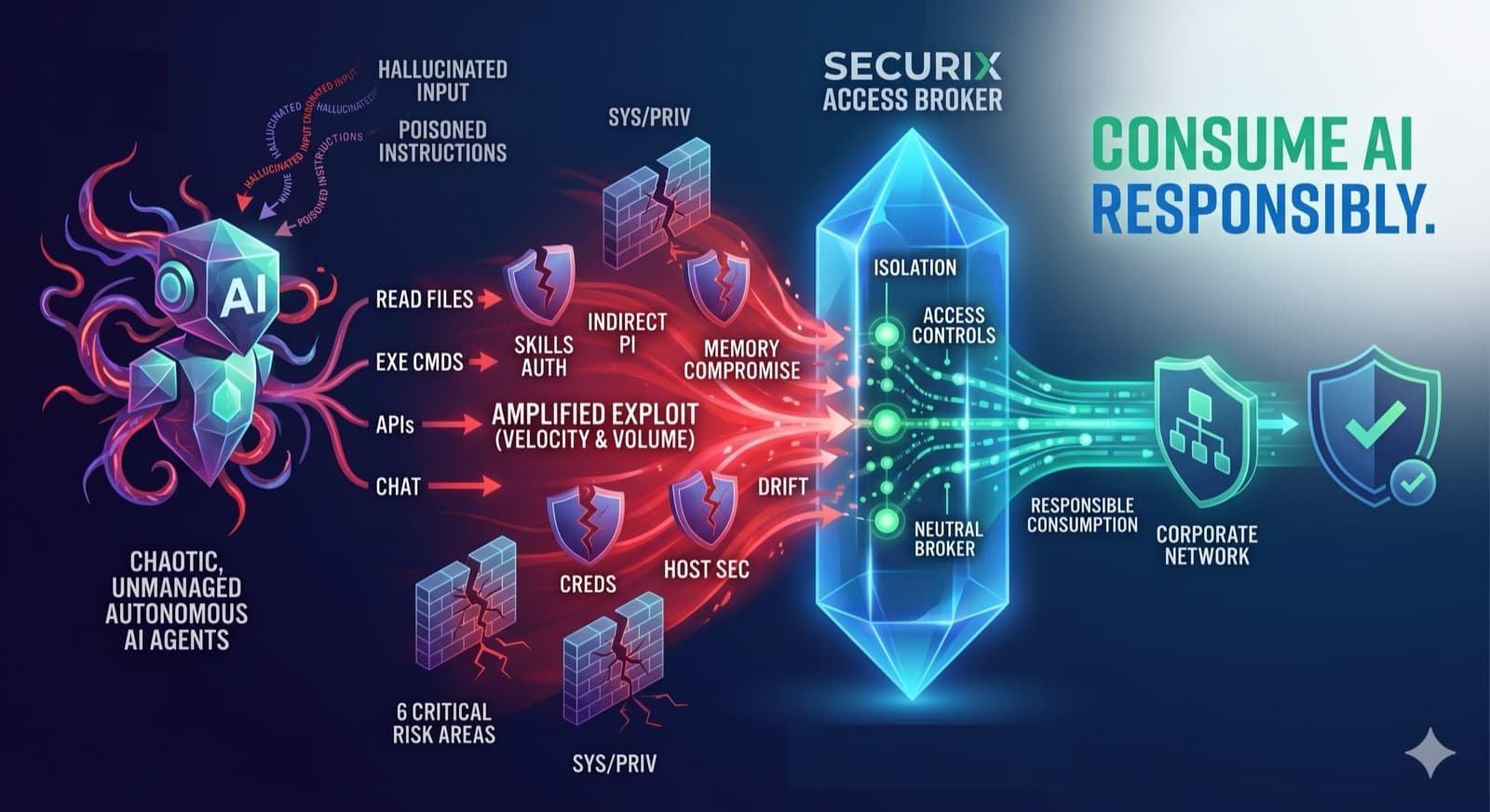
Deconstructing the Attack Surface: The LLM as an Action Engine
As illustrated in the core diagram of the lecture, the fundamental challenge is the amplification of existing risks when combined with autonomous execution. A malicious or hallucinated input doesn't just result in bad advice; in an agentic system, it leads to unauthorized system actions.
The traditional attack vector of hallucination and 'poisoning' inputs now impacts an autonomous system (LLM) which is directly connected to a toolchain ("Malicious Bugs"). This creates a cycle where bad input leads directly to bad system operations at unprecedented Velocity and Volume. While a Human In The Loop (HITL) process may exist, its efficacy is drastically reduced by the speed at which these automated systems can compromise a network.
This shifts the security burden. It is no longer just about preventing bad prompts; it's about securing the entire chain from prompt to system action.
The 6 Critical Risk Areas of Autonomous AI Agents
The breakdown in the lower right of the lecture whiteboard lists six critical points every security leader must address:
- Skills Authorization: The lecture highlights that agents gain "Skills" and access to tools. What limits what skills a specific agent can utilize? Just because an LLM can generate Python code doesn't mean it should be authorized to execute it on production systems.
- Indirect Prompt Injection: This is one of the most dangerous vectors. An agent with "READ FILES" access can have its behavior completely derailed by poisoned instructions found within a seemingly innocent text document, browser page, or API response. An external actor doesn't need to prompt the model directly to compromise it.
- Memory Compromise: Agents maintain state and persistent memory. This memory can store sensitive credentials or be poisoned over time, leading to cumulative compromise that is hard to detect and remediate.
- Credentials: To be useful, agents need credentials to access APIs and databases. The presentation clearly shows that agents become major repositories for these persistent, highly privileged credentials. A single agent compromise can grant an attacker keys to the entire kingdom.
- Drift: The lecture calls out drift as a key risk. Over time, as a model is exposed to more data and different contexts, its operational behavior can drift away from its designed security parameters, creating a moving target for defense.
- Host Security: The entire "Open Source" and "Self-Hosted" nature of many agent platforms means the security of the host machine itself is paramount. If the host running the model is compromised, everything else is lost.
SecuriX: Broker-Level Access Security is the Solution
The central message on the whiteboard lecture is clear: CONSIDER: UNTRUSTED CODE, INDIRECT PROMPT INJECTION. In an agent-driven world, trusting code or inputs is a strategic error.
SecuriX Agent Access Security Broker was designed precisely to mitigate these amplified risks at scale. As a neutral broker between your critical infrastructure and the untrusted outputs/actions of an AI agent, SecuriX provides the vital isolation and compromise control that the lecture emphasizes.
We don't try to make the LLM perfect; we make your infrastructure safe from it. By establishing robust broker-level access controls on what specific actions agents can take and what resources they can access, we ensure you can harness the power of AI agents while fulfilling the core mandate: Consume AI Responsibly.
Watch the Full Video Lecture
For a detailed walkthrough of the concepts discussed in this post, we highly recommend viewing the original presentation:
Video Credit: This blog post is based on the expert insights and framework presented on the whiteboard in this video. Link: https://www.youtube.com/watch?v=7qZH3D7u-z8
This post is part of SecuriX's mission to make enterprise AI secure, compliant, and trustworthy.
Community Forum
Questions, Feedback & Discussions
Join the conversation
Recent Discussions 0 Comments
No questions yet. Be the first!