The Case Against Building Your Own MCP Security
Why building an MCP security layer in-house is an architectural nightmare for B2B SaaS platforms and why offloading this infrastructure accelerates enterprise sales.
The rush to make B2B software "AI-ready" has created a new standard for integration: the Model Context Protocol (MCP). If your platform houses valuable data, the mandate from your product team is clear—build an MCP server so external AI agents can connect, query, and mutate your data seamlessly.
Building the MCP server itself is straightforward. You map your internal APIs to tool calls, write a few JSON schemas, and test it locally. It works flawlessly.
Then, you ask the Enterprises to adopt this new AI integration, and your deployment hits a brick wall.
The security team looks at your open MCP server and asks four questions:
- "How do we guarantee this external AI agent won't execute a prompt injection that deletes our CRM records?"
- "Can we restrict the agent to 'Read-Only' access on a per-user basis?"
- "How are you masking our customers' PII before the payload hits the LLM?"
- "Where is the immutable audit log proving exactly which AI agent executed which tool call?"
Suddenly, your simple API integration has morphed into a massive, enterprise-grade cybersecurity project.
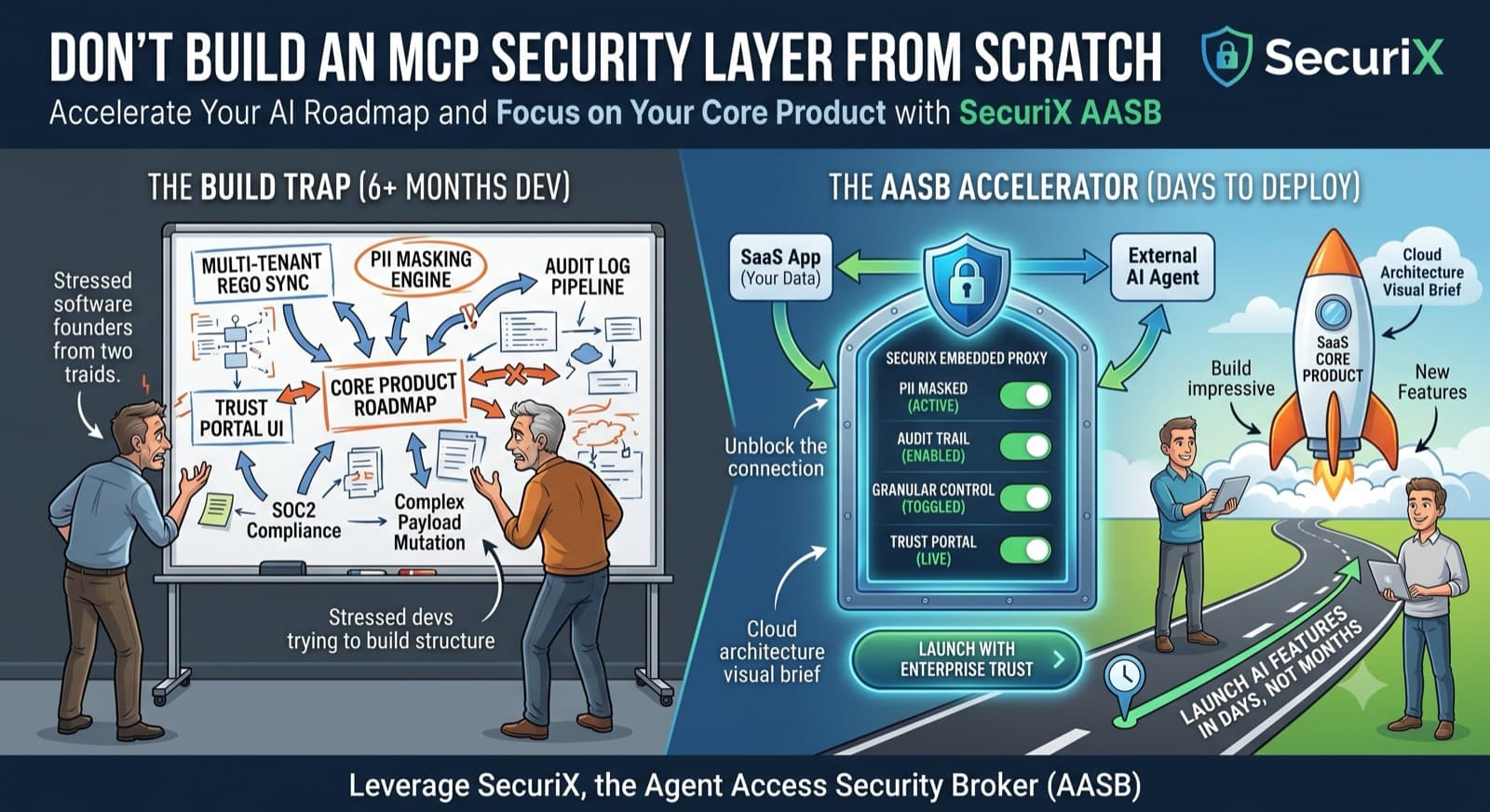
The Illusion of Simplicity: Why Open-Source Isn't Enough
The instinct of any strong engineering team is to build the governance layer in-house. You might pull down Open Policy Agent (OPA) or write a custom middleware script using policy.rego to validate the incoming tool calls.
For a single tenant, this works. For a B2B SaaS platform serving thousands of enterprises, it is an architectural nightmare.
The complexity doesn't lie in the access control; it lies in the multi-tenant state management and payload mutation. AI agent tool calls are fundamentally different from traditional, deterministic API requests. An LLM might decide to fetch 10 records or 10,000. It might hallucinate a parameter.
To govern this safely, your team has to build:
- Dynamic Policy Streaming: You can't hardcode rules. You need a control plane that programmatically routes and updates thousands of distinct customer policy profiles (Acme Corp wants PII masking; CorpB wants row-count budgeting) into local OPA memory caches in real-time, without cross-tenant data leaks.
- Complex Payload Mutation: OPA is natively designed for binary Allow/Deny decisions. AI governance requires deep string manipulation, data trimming, and regex scrubbing inside the actual JSON response to mask data before the external LLM sees it.
- Asynchronous Compliance Logging: You must build an append-only log-streaming pipeline that captures raw JSON-RPC payloads, strips out confidential credentials, handles backpressure when traffic spikes, and stores it in a searchable SIEM format.
- The Enterprise UI (The "Trust Portal"): You have to build a complete, white-labeled dashboard so your customer's IT admins can actually toggle these kill-switches and view the logs themselves.
The Ultimate Build vs. Buy Calculation
If you commit to building this infrastructure internally, here is the harsh reality of the opportunity cost: you are pulling a pod of your most senior backend and security engineers off your core product roadmap for 4 to 6 months.
During that half-year, your team is writing regex scrubbers, balancing Docker sidecars, and agonizing over SOC2 audit trails just to get your AI features out the door. Meanwhile, your competitors are shipping actual platform features.
Infrastructure is only a competitive advantage if it is your core business. For B2B SaaS vendors, an MCP security layer is a prerequisite for enterprise sales, not a product differentiator.
Offload the Infrastructure, Accelerate the Sale
This specific engineering bottleneck is why we are building the SecuriX Developer Layer.
Instead of reinventing multi-tenant AI governance from scratch, developer teams drop our lightweight proxy wrapper directly in front of their custom MCP servers. It sits completely within your cloud environment—meaning zero sensitive customer data ever leaves your VPC.
What you get out of the box is a fully functional, White-Labeled Trust Portal powered by an ultra-low-latency OPA engine. You instantly hand your enterprise buyers the exact granular controls, PII masking toggles, and SIEM-ready audit logs their security teams demand.
You don't need to spend six months building an Agent Access Security Broker (AASB). You just need to drop one in, unblock your enterprise compliance reviews, and get back to building the software your customers actually pay you for.
Community Forum
Questions, Feedback & Discussions
Join the conversation
Recent Discussions 0 Comments
No questions yet. Be the first!