- Published on
SecuriX Is Now the Enterprise AI Gateway
We have spent the past several months talking to IT leaders, engineering managers, and CFOs across companies ranging from 50 to 5,000 employees. We showed them the AASB concept — an Agent Access Security Broker that governs how AI agents access enterprise tools. Most people said the same thing:
"That makes sense. But our problem right now is that I'm paying $20/seat for everyone and I have no idea what any of them are actually doing with AI."
That was the signal we needed.
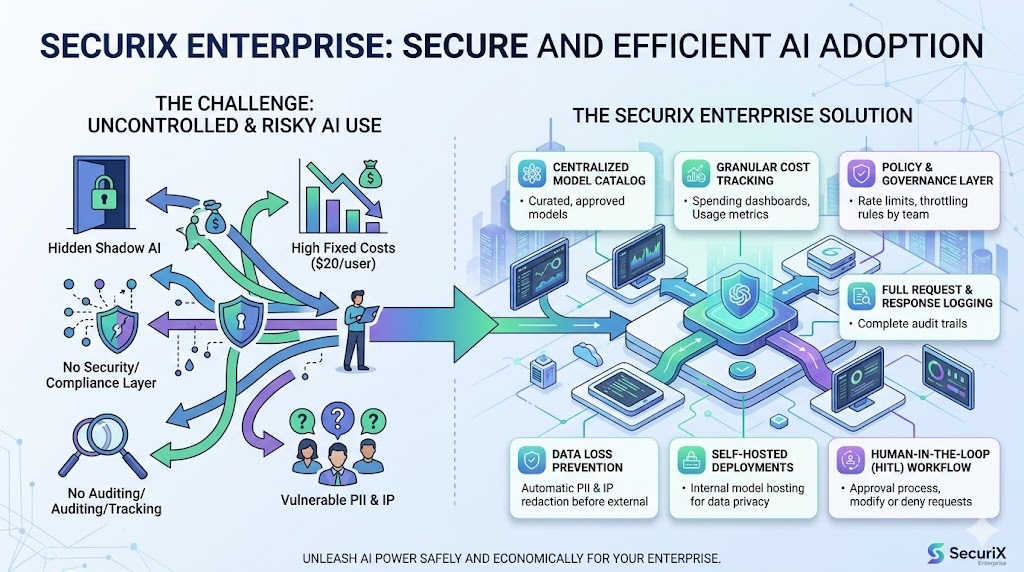
What We Built vs. What Enterprises Actually Need
The AASB concept was technically correct. Enterprises do need a security layer between AI agents and the tools they call. OAuth is too coarse for agentic access patterns. Policy-as-code is the right governance model. These ideas hold.
But we were solving the problem from the wrong entry point.
When an IT director walks into their CTO's office today, they are not saying "our AI agents have overly broad OAuth scopes." They are saying:
- "We're spending $180,000 a year on ChatGPT seat subscriptions and I can't tell you whether 60% of those people used it more than twice."
- "Someone pasted a customer's credit card number into an AI prompt. I found out from a vendor audit, not from us."
- "Legal wants an audit trail of every AI conversation for the last 6 months. I have nothing."
These are the problems that get budget approved. These are the fires that already exist. An AASB that governs agentic MCP tool calls is the right long-term architecture — but it answers a problem enterprises don't have acute pain around yet.
A shared LLM Gateway that cuts their AI bill in half on day one, gives them a full audit trail from day two, and blocks PII from reaching external models on day three — that gets a purchase order.
The Three Problems We Are Solving
We have reorganized everything SecuriX does around three problems that enterprises are willing to pay to solve today.
01 — The Per-Seat Subscription Trap
Seat-based AI pricing assumes every employee uses AI at the same rate. That assumption is wrong in every company we have spoken with. Engineering uses 8x what finance uses. Sales uses 4x what HR uses. When you pay per seat, you are subsidizing the median so that the tail can get value.
A shared LLM Gateway changes this model completely. One Chat API key from OpenAI or Anthropic. Route all company AI through a single proxy. You pay for tokens consumed — not seats allocated. Set monthly token budgets per department and enforce them at the gateway before any overage reaches the provider.
What we are building here: Chat API key vault, team budget allocation with hard enforcement, a built-in chat portal that employees access via SSO (no personal accounts, no app installs), and per-model routing so cost-sensitive teams use cheaper models by default. The full cost story — including a savings calculator — lives on our AI cost optimization page.
02 — The Prompt Black Box
Without a gateway, you know nothing about your company's AI usage. You do not know which employees are using it, what they are asking, which models are driving your costs, or whether sensitive data was shared. The monthly invoice tells you the total. That is all.
This is not a theoretical problem. It becomes a real one when a regulator asks for an AI audit trail, when an employee's account is compromised and you need to know what it accessed, or when a board member asks you to justify the AI spend.
A gateway that sits between every employee and every AI provider gives you an audit record for every request from the moment it deploys. Every request is recorded and attributed to an employee via SSO identity in an immutable audit trail, with content retained where DLP or policy flagged it. OPA Rego policies run on every request — you can enforce rules like "do not allow external models to see documents tagged Confidential" in code, version-controlled in Git.
What we are building here: Prompt audit logs, user and team token dashboards, OPA Rego policy engine with Git sync, anomaly detection for usage spikes and off-hours access.
03 — PII Reaching LLMs
This is the problem that keeps security teams awake. Employees are not malicious. They are efficient. A support agent copies a ticket with a customer's phone number and asks AI to draft a response. An engineer pastes a database query result to debug it — the result contains SSNs. A sales rep summarizes a CRM contact record — the prompt includes email addresses and deal values.
All of this data reaches OpenAI or Anthropic's servers in plain text.
A DLP engine at the gateway layer intercepts this before the prompt leaves the organization. SecuriX classifies credit card numbers (Luhn-validated), phone numbers, customer emails, SSNs, and API keys — and redacts them before they reach the LLM. The same protection applies to MCP tool responses: when Gmail returns an email thread containing PII, SecuriX redacts it before the model processes it.
What we are building here: DLP engine with configurable classifiers, MCP tool layer for Gmail/Drive/Calendar with Rego policy enforcement on both request and response, and PII redaction on tool outputs.
What Stays the Same
The core architecture does not change. SecuriX is a proxy. Everything goes through it. Policies run at the gateway layer. The data plane is yours; the control plane is ours.
The technical decisions we made early — OPA Rego as the policy language, MCP as the tool protocol, immutable audit logs — were correct. We are building on them, not away from them.
What changes is the entry point. We are not leading with "govern your AI agents." We are leading with "here is how to cut your AI bill in half and see what your company is actually doing with AI, starting this week."
The Personal Tier: Try Before You Pitch
One pattern we kept seeing: a developer or manager would evaluate SecuriX individually, get excited, and then face an internal sales process to get IT to adopt it at the company level.
We are making this explicit. The personal tier is your evaluation environment. You add your own OpenAI or Anthropic API key. You get a personal LLM gateway endpoint and a chat portal with Gmail, Drive, and Calendar MCP tools pre-connected. Rego policy enforced on every tool call.
Use it. Show it to your IT lead. Show them the audit log, the token dashboard, the DLP redaction. That is the demo. When they are ready, the enterprise migration is just connecting the admin key and setting up SSO.
What Is Coming
We are in active development. The immediate focus is the Gateway Core — Chat API key vault, SSO integration, team budget enforcement, built-in chat portal, and the prompt audit log. DLP and MCP tool enforcement ship alongside it.
From there we move into deeper observability (team dashboards, anomaly detection, per-model cost breakdowns) and compliance tooling (SOC2 audit exports, SIEM streaming, Git-synced policy deployment).
If you are evaluating AI governance tools — or sitting on a per-seat subscription bill that feels wrong — we want to talk to you.
Book a demo — we'll walk you through the platform and show you how to cut your AI costs.
Why We Are Telling You This
Repositioning is uncomfortable. It is easier to quietly update a website and hope nobody noticed the old version. We are writing this post because the enterprises we want to work with deserve to understand why we made this call and what we are building toward.
The AASB vision was right about the destination. The Enterprise AI Gateway is the on-ramp that gets enterprises there from where they actually are today — dealing with runaway per-seat costs, no audit trail, and PII that has already been reaching LLMs for months.
If you have been following SecuriX for a while: the core technical vision is intact. The entry point has changed because we listened.
If you are new here: this is what we are building. A proxy that routes all company AI, cuts your per-seat costs, audits every prompt, and blocks PII before it leaves your org. Deployable in a day.
Welcome to the Enterprise AI Gateway.
— The SecuriX Team
See SecuriX in front of your own traffic.
Tell us where to reach you and we'll set up a walkthrough with your identity provider, your policies, and your budget structure.