Solving the Agentic Last Mile
Why AI Agents Break Zero Trust (and How We Fix It)
The transition from basic chatbots to autonomous multi-agent systems is accelerating. But as we hand over the keys to these agents, a massive security vulnerability is emerging in enterprise architectures.
IBM Technology recently released a video highlighting the "Agentic Last Mile Identity Problem." Watching it, I found myself nodding along—this is precisely the exact problem we set out to solve with SecuriX at Catalyst Ops.
If you are building agents that connect to enterprise data, here is why your current setup is likely breaking Zero Trust, and how we can architect a solution.
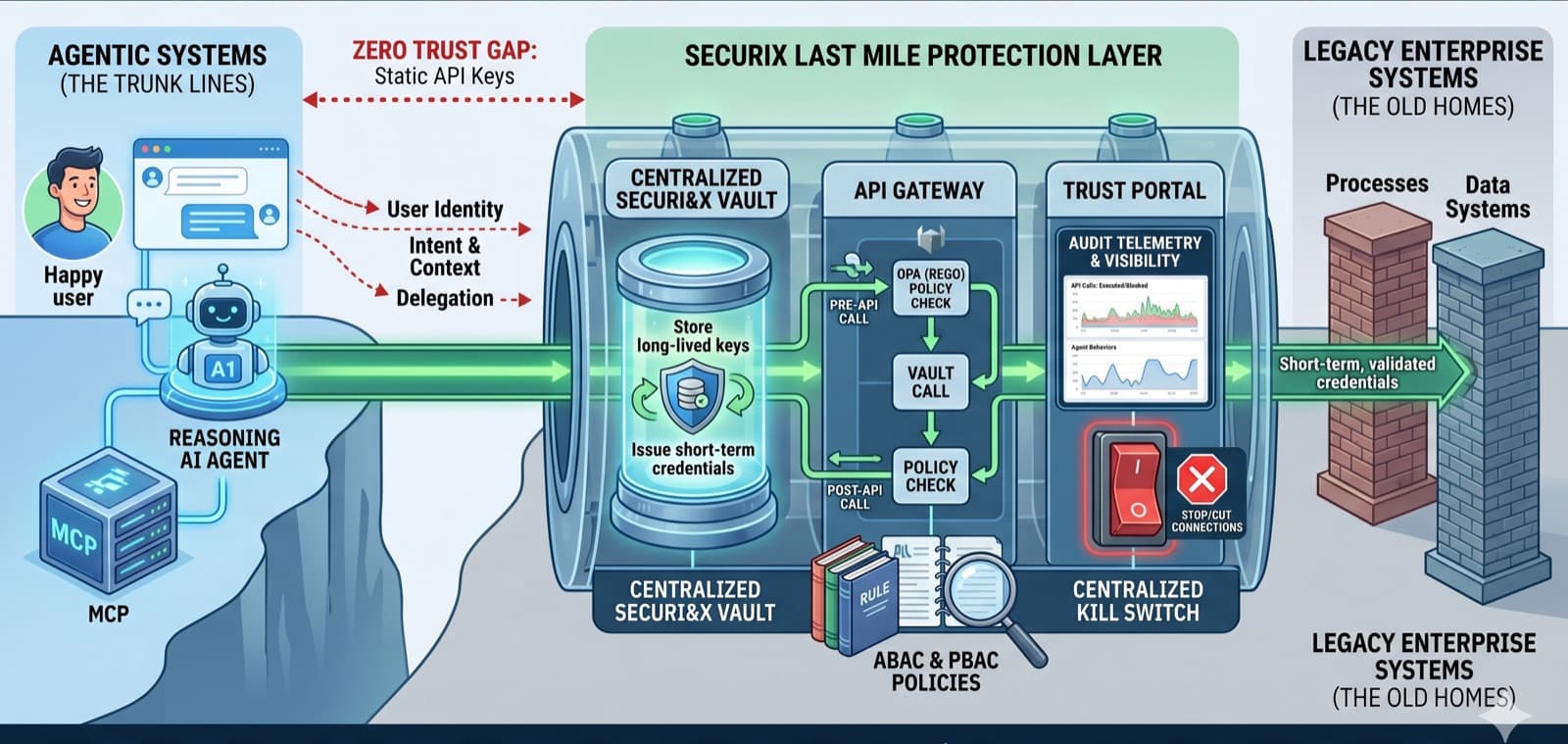
The Last Mile Challenge
The video uses a brilliant analogy: internet providers used to build super-fast trunk lines, but struggled to get those high speeds into older homes with outdated infrastructure.
In the AI era, our "trunk lines" are highly intelligent LLMs and reasoning engines. Our "old homes" are legacy enterprise systems. The problem occurs at the connection point.
When an agent executes a tool call on behalf of a user, it usually connects to backend processes using a static, shared API key. At that moment, the backend system completely loses track of:
- Identity: Who actually initiated the prompt?
- Intent & Context: Why is the agent making this change?
- Delegation: Is this agent actually authorized to act on this specific user's behalf?
Without this data, Zero Trust shatters. Unguarded agents can blindly chain tools together, essentially turning the agentic system into a prime target for attackers looking to infiltrate backend data.
Bridging the Gap: Theory vs. Implementation
IBM’s architectural recommendations to fix this vulnerability rely on validating identity, implementing policies, using a vault, and gathering telemetry.
After 13 years of building enterprise architecture, I know that theory only matters when you can ship it. Here is how we took those core concepts and built them into SecuriX as a B2B developer-facing infrastructure API layer to protect the last mile.
1. The Centralized Vault for Agent Tool Calls
The Concept: Introduce a vault to bridge agentic systems and legacy enterprises, managing credentials securely.
The SecuriX Implementation: We built a dedicated vault specifically for storing the credentials and tokens created for agents during tool calls. Instead of leaving long-lived API keys scattered across different platforms, SecuriX centrally manages them, ensuring rogue agents cannot bypass standard authentication paths.
2. Policy-Based Access Control (ABAC) via Policy-as-Code
The Concept: Implement ABAC and PBAC to validate the subject and environment before granting access.
The SecuriX Implementation: We enforce Policy-based ABAC directly at the API Gateway layer using Open Policy Agent (OPA) and Rego. We evaluate policies pre-API call against the request object, and post-API call against the response object. This guarantees that an agent's actions are strictly confined to the user-defined boundaries before any enterprise data is exposed.
3. Telemetry and The Centralized Kill Switch
The Concept: Collect behavioral telemetry to dynamically deny or narrow permissions.
The SecuriX Implementation: Visibility is useless without immediate control. We maintain comprehensive audit data telemetry for every single API call—whether executed or blocked. Furthermore, we operationalized this telemetry by building a centralized kill switch into our Trust Portal. Instead of toggling between multiple third-party connection settings during a breach, you can cut an agent's connection in one single place.
Protecting the Last Mile
Building autonomous agents is exciting, but scaling them for the enterprise requires fundamentally rethinking how we handle delegated access. We have all the architecture and building blocks in place to solve the Last Mile problem in this AI era.
🎥 A Recommended Watch
If you are building autonomous agents that need to securely connect to legacy enterprise systems, I highly recommend watching the excellent architectural breakdown by IBM Technology that perfectly mirrors our approach with SecuriX: https://youtu.be/SbrEk_tXZaE
This post is part of SecuriX's mission to make enterprise AI secure, compliant, and trustworthy.
Community Forum
Questions, Feedback & Discussions
Join the conversation
Recent Discussions 0 Comments
No questions yet. Be the first!