The Rise of MCP Apps: USB-C for AI
Everything you need to know about the Model Context Protocol (MCP), its explosive growth, and why security is the missing piece.
In November 2024, Anthropic introduced the Model Context Protocol (MCP) — an open, standardized interface that lets AI models talk to external tools, databases, APIs, and services in a uniform way. Think of it as USB-C for AI applications: before MCP, connecting a language model to your CRM, codebase, or internal knowledge base required bespoke integrations for every combination of model and tool. MCP collapses all that complexity into one standard.
In 18 months, it went from a niche open-source proposal to the de facto protocol connecting every major AI model to enterprise data — with 5,800+ servers, 97 million downloads, and commitments from OpenAI, Microsoft, Google, and AWS. Here's everything you need to know, and why security can't be an afterthought.
What Are MCP Apps, Really?
An MCP App (or MCP server) is a packaged integration — a lightweight service that exposes a specific capability through the MCP protocol. Search your Google Drive, query your database, post to Slack, read your calendar. AI clients — Claude, GPT-4, Gemini, Copilot — can discover and invoke these apps automatically. The result: AI agents that can take real actions in real systems, not just generate text.
The analogy that sticks: MCP is to AI agents what HTTP is to the web. It's the transport layer that makes the whole ecosystem possible — and it's already become the industry default.
The growth has been explosive. From a few dozen reference implementations in late 2024, the ecosystem crossed 1,000 servers by early 2025 and 5,800+ by March 2026. Developer tooling (1,200+ servers) came first — AI coding assistants were the early adopter wave. Business application servers (950+) followed as enterprises started deploying AI agents into customer service, sales automation, and internal operations.
Who Is Building MCP Apps?
What started as an Anthropic open-source project became an industry-wide commitment faster than almost any other protocol in recent memory.
Anthropic
Created and maintains the reference implementation. MCP is fully supported in Claude Desktop, Claude API, and Claude Code. The spec continues to evolve through community Specification Enhancement Proposals (SEPs).
OpenAI
Committed to MCP support in 2025, bringing GPT-4 and o1 models into the ecosystem via the Assistants API tool framework. This single decision ended provider-specific tool format fragmentation and confirmed MCP as the industry standard.
Microsoft
Incorporated MCP directly into Azure AI Agent Service (May 2025), enabling access to real-time web data via Bing Search and private enterprise data via Azure AI Search. Now supports MCP across Microsoft 365 Copilot.
Google DeepMind
Added MCP support across its model platforms, reinforcing the protocol's cross-vendor status. Gemini models can now act as MCP clients in enterprise agent pipelines.
Salesforce, Cloudflare, Auth0, New Relic
Summer 2025 marked the unofficial launch of production-grade governance for MCP — with Salesforce anchoring interoperability, Cloudflare delivering approval workflows, Auth0 providing identity-layer integration, and New Relic launching MCP observability.
AWS & Cisco
Cisco's AI Defense solution expanded in early 2026 to add runtime protections against tool abuse and supply chain manipulation at the MCP layer. AWS has followed with joint guidance on securing MCP and Agent-to-Agent (A2A) deployments at scale.
The Center for Internet Security published a formal MCP Companion Guide in April 2026 — a watershed moment that signaled MCP is now infrastructure-grade, not just developer tooling. The Coalition for Secure AI (CoSAI) has made MCP security one of its primary research areas, leading discussions at RSAC 2026.
The Security Problem Nobody Solved — Until Now
Here's the tension at the heart of MCP's success: the same openness and connectivity that makes MCP so powerful is exactly what makes it dangerous. Every MCP server you connect to is a new path from an AI agent into your organization's crown jewels.
Sobering stat: Only 29% of organizations reported being prepared to secure their agentic AI deployments — yet 80.9% of technical teams had already moved past planning into active testing or full production deployment.
Security researchers and practitioners have identified a cluster of critical risks that compound as MCP adoption accelerates.
Tool Poisoning
Malicious MCP servers lie about their functionality through hidden instructions or weaponized metadata, manipulating AI behavior without the user knowing. Advanced models like o1-mini show a 72.8% attack success rate in benchmark testing.
Sensitive Data Exfiltration
Overprivileged MCP connections allow agents to access far more data than they need. A fake npm package mimicking an email integration was found silently copying outbound messages to an attacker-controlled address.
Cross-Tool Attacks
Malicious MCP servers exploit shared conversation contexts to steal data from other legitimate tools connected in the same agent session — a new class of attack with no analog in traditional security.
Shadow AI & Sprawl
Individual teams deploy MCP servers without security review. Only 24.4% of organizations have full visibility into which AI agents are communicating with each other, let alone which MCP servers they're calling.
Supply Chain Tampering
Real CVEs exist. Figma's MCP server (CVE-2025-53967) allowed remote code execution via command injection. Microsoft's Azure DevOps MCP package (CVE-2026-32211, CVSS 9.1) shipped with a missing authentication layer on a server handling work items, repositories, and pipelines.
Privilege Escalation
Without session binding and token lifecycle management, stolen credentials give attackers persistent access that looks like legitimate agent behavior — invisible to traditional identity and access controls.
The enterprise security gap is structural, not accidental. Security teams have done solid work controlling the model layer — which AI tools employees can access, which vendors pass procurement review. But this leaves the execution layer completely open. In 2026, the execution layer is where attacks actually happen: through tool invocations, API calls, database writes, and automated workflows triggered by AI agents.
Where SecuriX Fits
Most organizations are handing AI agents the keys to the kingdom with no policy layer in between. SecuriX is built specifically to close this gap.
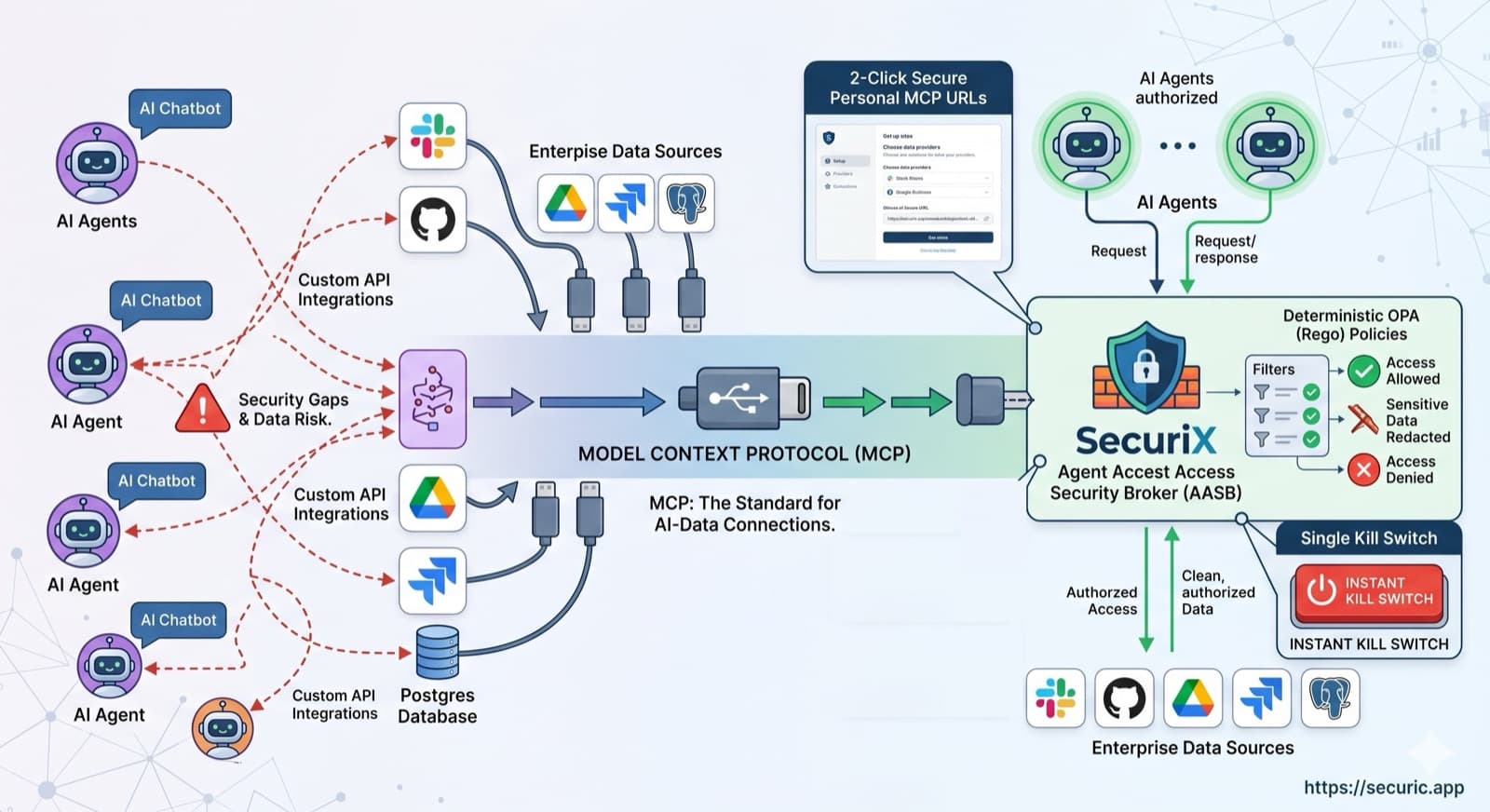
We are an Agent Access Security Broker — we sit between your AI agents and chatbots and your enterprise data, applying deterministic, auditable policy at every interaction through the SecuriX AI gateway.
Unlike probabilistic AI guardrails that guess at intent, SecuriX uses OPA (Rego) policies — the same engine trusted by Kubernetes, cloud infrastructure, and enterprise compliance teams. Every request and response is evaluated against policies you define, version, and audit. No surprises. No gaps.
What this looks like in practice:
- Secure MCP URLs in 2 clicks. Choose your providers — Google Drive, GitHub, Slack, your internal APIs — and get a hardened personal MCP URL instantly. No code, no config files, no DevOps ticket.
- One kill switch across all providers. Revoke access to any MCP integration instantly, without touching individual tools or hunting down credentials scattered across your org.
- Granular OPA (Rego) policies applied deterministically over every request and response — hard policy enforcement, not probabilistic guardrails.
- Full audit trails on every agent action, across every connected MCP provider, in one place.
- Provider-agnostic. Works across Claude, GPT, Gemini, and any MCP-compatible agent or chatbot.
The security gap between what enterprises are deploying and what they can actually govern is the defining risk of the current AI moment. SecuriX is built to close it — without slowing your teams down.
The Bottom Line
MCP Apps are not a passing trend. They are the infrastructure layer through which AI agents will interact with every enterprise system, dataset, and workflow for the foreseeable future. The major AI providers have all committed. The ecosystem has crossed 5,800 servers and 97 million downloads. The Center for Internet Security has issued formal guidance. This is infrastructure — and infrastructure needs governance.
The enterprises winning the next era of AI aren't the ones moving fastest to connect agents to data. They're the ones moving fastest to do it safely — with policy enforcement, audit trails, and a single control plane that doesn't slow them down.
That's exactly what SecuriX is built for. Two clicks to a secure MCP URL. Deterministic policy. One kill switch. The control you need to deploy AI agents without losing sleep.
Community Forum
Questions, Feedback & Discussions
Join the conversation
Recent Discussions 0 Comments
No questions yet. Be the first!