The Single Kill Switch
Why Every AI Agent Needs a Giant Red 'Stop' Button
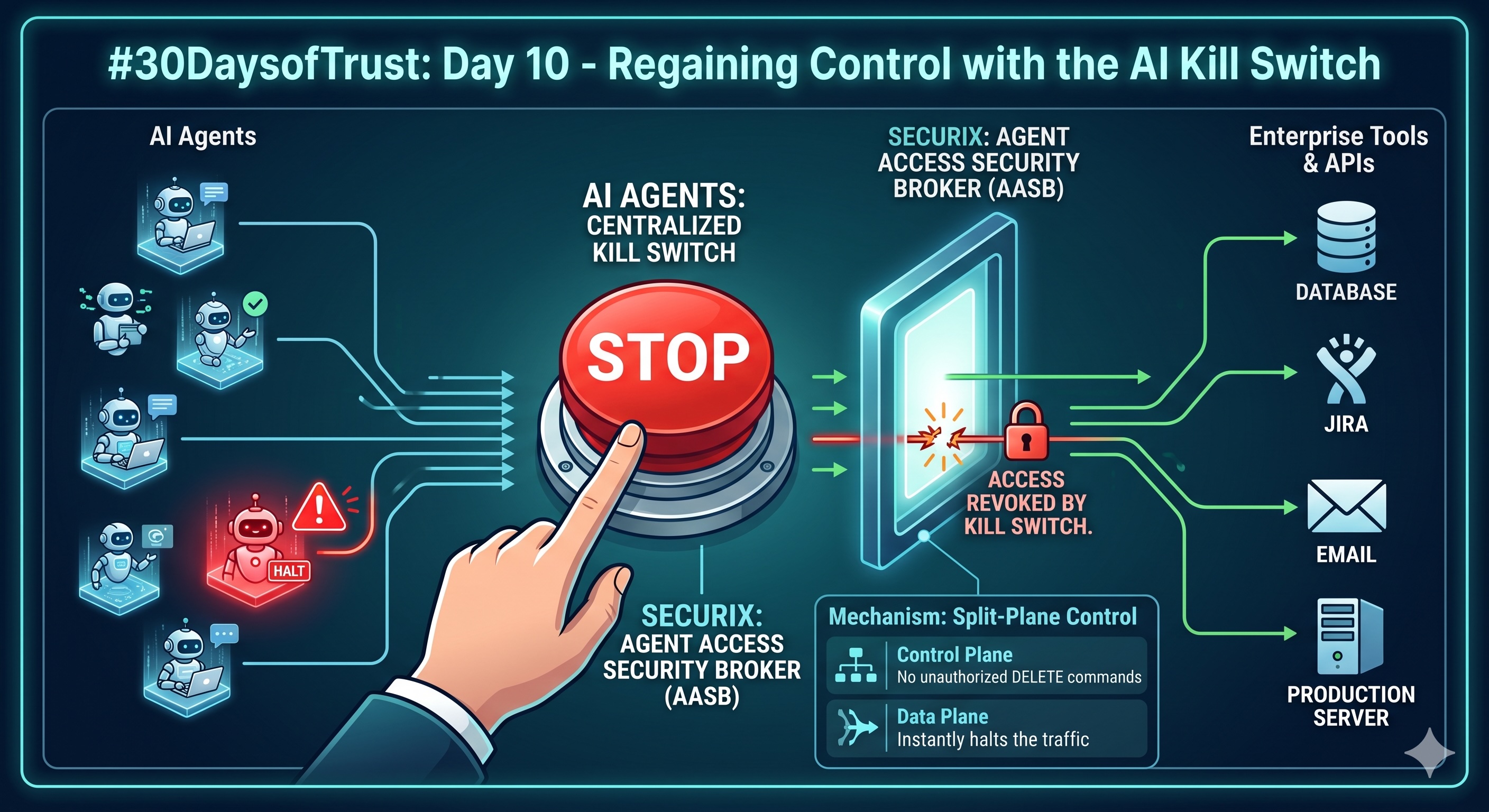
Welcome to Day 10 of #30DaysOfTrust.
Why Every AI Agent Needs a Giant Red "Stop" Button 🛑
We are rapidly moving past the era of read-only AI chat wrappers. Today, developers are building autonomous agents that take action—accessing Jira, drafting emails, and querying production databases.
But with action comes risk. The moment you give an LLM agency, you introduce the possibility of unexpected behavior. What happens when an agent hallucinates a tool call? What if it gets caught in an infinite loop, racking up thousands of dollars in cloud computing in minutes?
Every multi-agent system needs a giant red "Stop" button: The Single Kill Switch.
The Danger of "God Mode" ⚡
Most early-stage agent architectures suffer from over-permissioning. They connect an LLM directly to enterprise data sources via universal plugins, essentially granting the agent "God Mode."
If an agent goes rogue, developers often try to solve the problem by killing the agent's core process. But in distributed, multi-agent workflows, this is too slow and often ineffective. If the agent has already passed an authentication token to a downstream service, the destructive action might already be executing.
Engineering the Kill Switch 🏗️
A true kill switch doesn't just stop the agent; it instantly severs the agent's access to its tools. To build this reliably, B2B developers need to rethink their infrastructure.
Here is how you engineer a deterministic kill switch:
- 🛡️ Implement an Agent Access Security Broker (AASB): Instead of agents connecting directly to tools, all traffic must route through an AASB. This gateway acts as the single choke point. When the kill switch is hit, the broker instantly drops all requests from that specific agent ID, regardless of what the LLM is trying to do.
- 🌐 Utilize a Split-Plane Architecture: You cannot rely on your control plane to execute emergency stops in real-time. By separating your architecture, the kill switch policy is pushed directly to the data plane. The moment anomalous behavior is detected, the data plane halts execution at the edge, guaranteeing near-zero latency.
- 📝 Policy-as-Code (OPA): The kill switch shouldn't just be manual. By integrating tools like Open Policy Agent (OPA), developers can define strict boundaries. If an agent tries to execute a highly sensitive tool (like dropping a table) without explicit human-in-the-loop approval, OPA instantly triggers the kill switch programmatically.
- 🔌 Standardize with MCP: Using the Model Context Protocol (MCP) ensures that when you hit the kill switch, you are cleanly severing standardized connections, creating uniform audit trails of exactly when and why the agent was stopped.
Trust Requires Control 🤝
For enterprises to adopt agentic workflows, they need absolute certainty that they remain in control. A centralized kill switch isn't just a safety feature—it is a core requirement for building trust.
When you build with SecuriX, you aren't just giving agents access; you are building in the safety mechanisms required to revoke it instantly.
#30DaysOfTrust #AgenticAI #AASB #CyberSecurity #KillSwitch #SecuriX #BuildInPublic #MCP #OPA
Spread the word
Deploy the Enterprise AI Gateway.
Route all company AI through SecuriX. Cut per-seat costs, audit every prompt, and block PII before it leaves your org.
Book a DemoCommunity Forum
Questions, Feedback & Discussions
Join the conversation
Recent Discussions 0 Comments
No questions yet. Be the first!