- Published on
Cut Enterprise AI Costs in Half
Most companies discover their AI spending problem the same way: a finance review flags a recurring line item — 30 per seat, multiplied across hundreds of employees — and someone asks the obvious question. "Are all of these people actually using this?"
Nobody can answer. That is the real problem. Not the cost. The blindness.
An enterprise LLM gateway fixes both at once. This guide explains what it is, how it cuts your AI bill in half on day one, and why it has become the default way mid-market and enterprise companies govern AI in 2026.
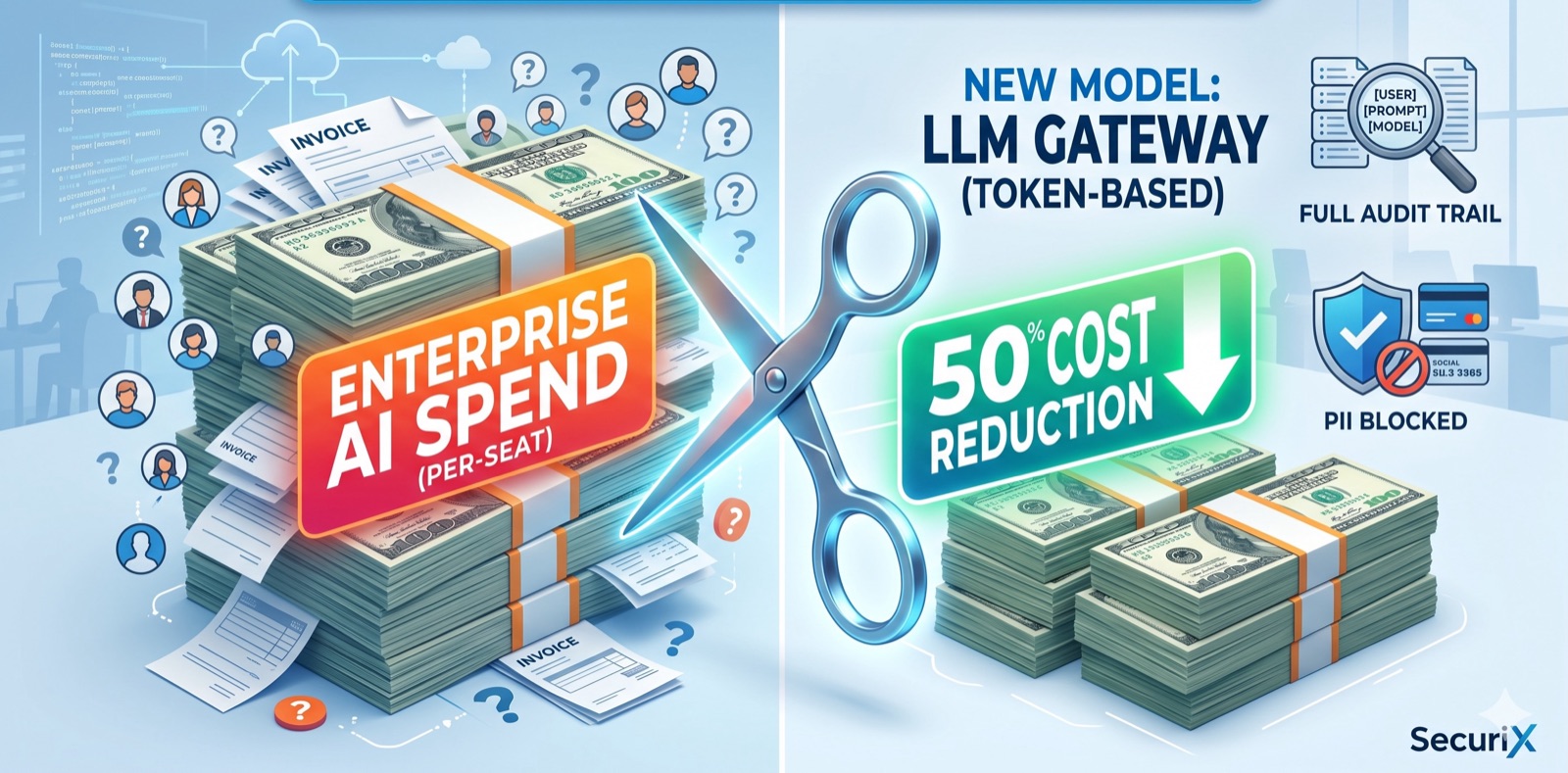
What Is an Enterprise LLM Gateway?
An enterprise LLM gateway is a proxy that sits between your employees and AI providers like OpenAI, Anthropic, and Amazon Bedrock. Every prompt and every response routes through it. Because all traffic passes through one control point, the gateway can do three things no per-seat subscription can:
- Bill by tokens consumed, not seats allocated — so you stop paying for licenses nobody opens.
- Record every request — so you have a complete, attributable audit trail, with prompt content retained where policy flagged it.
- Inspect and redact data in flight — so credit card numbers, SSNs, and customer PII never reach an external model.
Instead of buying a license for each person, you connect one Chat API key and give employees a built-in chat portal through single sign-on. You pay for what they actually use. You see everything they do. And you enforce policy before any data leaves your network.
That is the whole idea. The rest of this guide is about why it matters and what it saves you.
The Per-Seat Subscription Trap
Seat-based AI pricing assumes every employee uses AI at the same rate. That assumption is wrong in every company we have spoken with.
Engineering uses roughly 8x what finance uses. Sales uses about 4x what HR uses. When you pay per seat, you are subsidizing the median so that a small power-user tail can get value — and paying full price for the long list of employees who logged in twice in onboarding and never came back.
Here is what that looks like in practice for a 500-person company:
| Per-Seat Licensing | LLM Gateway (Token-Based) | |
|---|---|---|
| Pricing model | Fixed fee × every seat | Pay only for tokens consumed |
| Idle / low users | Paid in full | Cost ≈ $0 |
| Annual cost (typical) | ~$180,000 | ~90,000 |
| Usage visibility | None — just the invoice | Per-user, per-team, per-model |
| Vendor lock-in | One provider per contract | Swap OpenAI / Anthropic / Bedrock freely |
| Budget control | None until renewal | Hard per-team caps enforced live |
The savings are not marginal. For most companies, moving from per-seat licensing to a token-based gateway cuts the AI bill by 40–60% — without removing access from a single person who actually uses it. Run your own numbers with the savings calculator on our AI cost optimization page.
You also break vendor lock-in. With a gateway, the model is a configuration choice, not a contract. Route cost-sensitive teams to cheaper models by default, send complex work to frontier models, or point everything at a model you host yourself in Bedrock. No migration project required.
See Your AI Spend Cut in Half
Book a demo of SecuriX. We'll show you how to cut per-seat AI costs across your organization.
The Prompt Black Box: Why You Can't See Your AI Usage
Without a gateway, you know almost nothing about your company's AI usage. You do not know which employees use it, what they ask, which models drive your costs, or whether sensitive data was shared. The monthly invoice tells you the total. That is all.
This stays abstract until the day it isn't:
- A regulator asks for an AI audit trail covering the last six months. You have nothing.
- An employee account is compromised and you need to know what it accessed. You can't tell.
- A board member asks you to justify the AI spend line by line. You can't.
A gateway gives you an audit record for every request from the moment it deploys — attributed to an employee through SSO identity and stored immutably, with prompt content retained where policy or DLP flagged it. You get per-user and per-team token dashboards, model-level cost breakdowns, and anomaly detection for usage spikes and off-hours access.
Governance runs as code. Policies execute on every request — rules like "do not allow external models to see documents tagged Confidential" — and they live in version control, not in a settings panel someone forgets to update.
Stopping PII Before It Reaches the Model
This is the problem that keeps security teams awake, and it is rarely malicious. Employees are just being efficient.
A support agent pastes a ticket containing a customer's phone number and asks AI to draft a reply. An engineer drops in a database query result to debug it — the result contains SSNs. A sales rep summarizes a CRM record, and the prompt carries email addresses and deal values. In every case, that data reaches an external provider's servers in plain text.
A data-loss-prevention engine at the gateway layer intercepts this before the prompt ever leaves your organization. SecuriX classifies and redacts credit card numbers (Luhn-validated), phone numbers, customer emails, SSNs, and API keys before they reach the LLM. The same protection applies in reverse: when a connected tool like Gmail returns an email thread containing PII, it is redacted before the model ever sees it.
You get the productivity of AI without exporting your customers' personal data to a third party.
What Employees Get: A Built-In Chat Portal With Your Data
A gateway is not just a cost-control layer — it changes how employees actually work.
The out-of-the-box chat portal we provide comes with the SecuriX MCP layer attached, so employees can interact with their company's own data — Gmail, Drive, Calendar, and more — instead of the alt-tab, copy-paste shuffle between tabs that leaks data in the first place. Every one of those tool calls is governed by the same policy engine and the same redaction rules as the chat itself.
You circulate one internal chat link, enroll everyone through SSO and SCIM, block the public AI chatbots at the network edge, and your whole company is on a single governed surface within a day.
How an LLM Gateway Compares to the Alternatives
vs. ChatGPT Enterprise / Copilot: Those are seat-based and single-vendor. A gateway is usage-based and vendor-neutral, with audit and DLP built in rather than bolted on.
vs. Banning AI outright: Bans create shadow AI. People use their personal accounts on personal devices, and now your data is leaving with zero visibility. A gateway gives a better sanctioned option, so there is no reason to go around it.
vs. Building it yourself: You can wire up a proxy, but budgets enforcement, SSO/SCIM, immutable audit logs, a policy engine, and a DLP classifier are a roadmap, not a weekend. A gateway ships them on day one.
Frequently Asked Questions
What is an LLM gateway in simple terms? It is a single checkpoint that all of your company's AI traffic flows through. It replaces per-seat licenses with usage-based billing, records every prompt for audit, and strips sensitive data before it reaches the AI provider.
How much can a company actually save? Most organizations moving from per-seat licensing to token-based access cut their AI bill by 40–60%, because they stop paying for the large share of seats that go mostly unused. Estimate your own savings with the AI cost savings calculator.
Does it lock us into one AI provider? No — the opposite. Because you connect Chat API keys rather than signing seat contracts, you can route different teams to OpenAI, Anthropic, or a self-hosted Bedrock model and switch any time.
Will it slow employees down? No. Employees use a built-in chat portal through single sign-on — no personal accounts, no app installs. For most users it feels exactly like the chatbot they already know, with their company data connected.
How does it stop data leaks? A DLP engine inspects every prompt in flight and redacts credit card numbers, SSNs, phone numbers, emails, and API keys before the request leaves your network — and applies the same redaction to data returned by connected tools.
How long does it take to deploy? A gateway can be live in a day: connect a Chat API key, configure SSO, set team budgets, and share the chat portal link.
Where to Start
If you are sitting on a per-seat AI bill that feels wrong — or you simply cannot answer the question "what is my company doing with AI?" — an enterprise LLM gateway is the fastest way to take back control of the cost, the visibility, and the data.
SecuriX is that gateway: route all company AI through one proxy, cut per-seat costs, audit every prompt, and block PII before it leaves your org. Deployable in a day.
Book a Demo
See SecuriX in action. Tell us where to reach you and our team will schedule a custom demo.
For the bigger picture on how we got here, read SecuriX Is Now the Enterprise AI Gateway. To go deeper on the security model, see Taming Shadow AI and Zombie Agents. If compliance is driving your evaluation, ISO 42001: AI Governance You Can Prove covers the evidence an auditor will ask for — or start with the AI cost optimization overview and explore the full platform on the Enterprise page.
— The SecuriX Team
See SecuriX in front of your own traffic.
Tell us where to reach you and we'll set up a walkthrough with your identity provider, your policies, and your budget structure.