- Published on
Breaking the AI Security Trilemma
There is an uncomfortable idea at the center of every enterprise AI program: the AI security trilemma. You want smart, you want speed, and you want secure — and you get to pick any two.
It is worth stating plainly because most AI strategy decks paper over it. Every enterprise AI team is already making this trade. Very few of them made it deliberately, and almost none of them wrote down which corner they gave up.
This post covers why the trilemma is real, what each of the three failure modes looks like in an actual organization, and why the constraint dissolves the moment security stops being a feature of your AI application and becomes a layer underneath it.
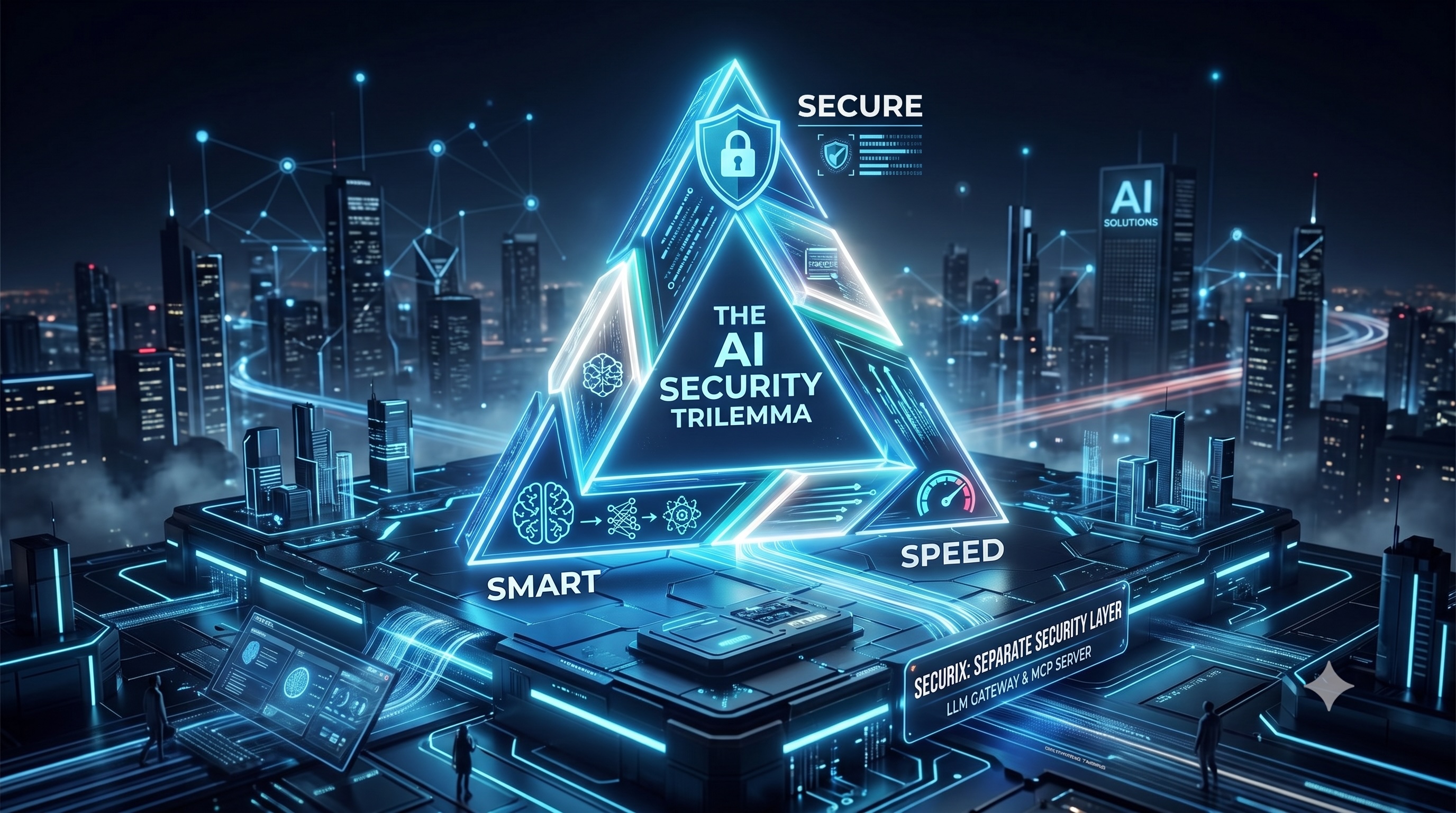
The three corners
Smart is capability. The frontier model rather than the cheap one. A large context window with real company data in it. Memory across sessions. Tools that reach live systems — the CRM, the ticketing system, the data warehouse — and the autonomy to chain several of them together without asking permission at each step.
Speed is latency and throughput. First token in a few hundred milliseconds. Streaming that does not stutter. No extra network hops, no synchronous scanning stage, no queue. Speed is not a vanity metric: below a certain responsiveness, people stop using the tool, and an AI program nobody uses returns nothing on its investment.
Secure is everything that wants to sit in the middle and look. Inspecting prompts before they leave. Redacting the customer record someone pasted in. Catching the injected instruction hidden in a retrieved document. Checking whether this agent is allowed to call this tool with these arguments. Logging all of it in a form an auditor will accept.
The tension is structural, not incidental. Smart wants more data, more reach, more autonomy. Speed wants fewer steps between the user and the model. Secure wants to insert steps and constrain reach. Optimize any two hard enough and the third gives.
Pick any two: what each choice looks like in practice
Smart + Speed (security is the sacrifice)
This is the default, and it is where most enterprises actually live right now — not by decision, but by drift.
Developers call the frontier model directly with their own keys. The agent framework gets broad credentials because scoping them properly was going to take a sprint nobody had. MCP servers are wired to production systems with a long-lived token. Nothing is in the path, so nothing is slow, and the results are genuinely impressive.
What you have is real capability and real speed with no idea what is leaving the building. The prompts are gone the moment they are sent. The provider dashboard shows token counts, not content. When someone eventually asks "has any customer PII gone to an external model?" — and someone always eventually asks — there is no place to look for the answer.
Smart + Secure (speed is the sacrifice)
The reaction to the above, usually arriving right after the first incident or the first audit.
Now every new use case goes through a review board. Every MCP tool gets a ticket before it is connected. DLP scanning runs synchronously in-line and adds seconds. A human approves anything that touches a customer record. The model is still the good one and the controls are real — the system is capable and it is genuinely safer.
It is also slow enough that people route around it. They go back to the consumer chatbot on their phone, or the personal API key, or the browser extension nobody catalogued. The governed path becomes the path of last resort, and you have quietly collapsed back into Smart + Speed — except now it is invisible to you and you are paying for a governance program. This is the most expensive corner of the triangle, because it looks like control while producing shadow AI.
Speed + Secure (intelligence is the sacrifice)
The lockdown. A small approved model, self-hosted. No external tool access. No internet retrieval. No sensitive data allowed in context, enforced by a blunt blocklist. Everything runs in a sandbox with nothing useful in reach.
It delivers speed, it is defensible in an audit, and it cannot do the job. Users try it twice, conclude that the company's AI is useless, and go elsewhere. You have optimized for the absence of incidents rather than for outcomes, which is a coherent strategy right up until a competitor with the same constraints ships something that works.
Why the trilemma binds
Look at what the three corners have in common in every scenario above: security is being implemented inside the AI application itself.
Guardrails in the prompt. Filtering in the agent loop. Credential handling in the framework config. Approval logic written into the workflow. When that is the architecture, all three properties compete for the same finite resources — the same context window, the same latency budget, the same request path, the same overloaded platform team. Every control you add is subtracted directly from capability or speed. The trade is real because it is happening inside one system.
It also means security scales with the number of applications rather than with the number of enforcement points. Ten AI applications means ten implementations of redaction, ten audit formats, ten sets of credentials, ten places to update when the policy changes, and ten different answers to "what is our AI actually doing?"
That is the assumption worth attacking. Not the trilemma — the architecture that makes it binding.
The escape: security as a separate layer
At SecuriX we are building exactly this — a security layer that sits beside the AI stack rather than inside it, at the two points where everything an enterprise AI system does has to pass through anyway.
The LLM gateway layer governs everything the model sees and says. Every prompt, every completion, every model, every user, across every application — one path.
The MCP server layer governs everything the agent does. Every tool call, every argument, every credential, every action against a real system — one broker.
Those two chokepoints are not arbitrary. Together they cover the full surface: the data going into a model, the data coming back, and the actions taken as a result. If you can see and govern both, there is very little left that can surprise you.
Here is why moving security out changes the arithmetic on all three corners.
Smart stays smart
When the blast radius is bounded at the action layer, you no longer have to lobotomize the model to feel safe. Route to the best model for each task — frontier for reasoning, cheap and low-latency for classification — because the gateway decides what a given user or agent is allowed to reach, not a hardcoded config. Give agents real tools against real systems, because each call is authorized individually against policy with scoped, short-lived credentials, rather than the agent holding a permanent key and your trust.
The distinction that matters: broker the capability, don't remove it. Most lockdowns happen because "allow" and "deny" are the only two options available. A layer that can express this agent, this tool, these arguments, this data class, right now replaces a blunt no with a precise yes.
Speed stays intact
Policy evaluation at the edge is a compute problem, and compute problems have engineering answers. Deterministic checks — identity, tool allowlists, argument policy, data classification — run in-path in single-digit milliseconds. Semantic caching returns repeat answers without a model round trip at all, which makes the governed path faster than the ungoverned one for a meaningful share of traffic.
The expensive checks get treated differently rather than being crammed into the request path. Deep behavioral analysis, anomaly detection across an agent's session history, and retrospective review run out-of-band on the log stream, where they can be as thorough as you like without a user waiting on them. And critically, the approval step is reserved for the small set of genuinely irreversible actions, instead of being the default gate on every interaction — which is exactly the mistake that makes the Smart + Secure corner unusable.
An honest caveat: a layer in the path is not free. It is a hop, and it costs some milliseconds. The claim is not that security becomes weightless. The claim is that you trade a small, bounded, engineered latency cost — the kind you can measure and optimize — for the entire security budget you would otherwise pay in capability, in review queues, or in incidents. That is a good trade, and it is a very different trade from the one the trilemma describes.
Secure gets stronger, not just cheaper
The counterintuitive result is that consolidating onto a layer produces better security than distributing it across applications, for reasons that have nothing to do with the controls themselves:
- Completeness is provable. One path means the answer to "is our inventory of AI usage complete?" is architectural rather than a survey of what teams remembered to declare.
- Policy is written once. A new rule takes effect everywhere on the next request. No coordinating ten teams through a change window.
- The audit trail is uniform. Prompts, completions, tool calls, arguments, and policy decisions in one schema — which is what turns "we have controls" into evidence an auditor accepts.
- Revocation is instant and total. One kill switch that actually reaches every application, rather than a scavenger hunt for keys.
This is what AI governance actually is
"AI governance" tends to get discussed as a documentation exercise — a policy PDF, a model register, a committee. The frameworks that matter, ISO 42001 and the EU AI Act among them, do not ask whether you wrote a policy. They ask whether you can demonstrate it was enforced, on every request, and show the records.
That is a runtime property. You cannot produce it from a document, and you cannot reliably produce it from ten application teams each doing their best. It falls out almost for free when there is a layer in the path that already sees every prompt and every tool call and already writes them down.
Governance stops being a program you run alongside your AI and becomes a byproduct of how the AI is wired.
Where to start
You do not have to solve the whole triangle at once. The sequence that works:
- Get one path. Put a gateway in front of model traffic before you write a single policy. Visibility first — you cannot govern what you cannot enumerate, and the inventory alone usually reframes the conversation.
- Broker the actions. Move agent tool access behind an MCP layer with scoped, short-lived credentials and per-call authorization. This is where the irreversible things happen, and it is the highest-leverage control you can add.
- Then tune the corners. With both chokepoints in place, model routing, caching, and policy become dials you can turn independently — which is the whole point. The team optimizing for capability and the team optimizing for latency stop negotiating against the team optimizing for safety, because they are no longer spending from the same budget.
If your AI program is currently sitting in one of the three corners and you know which one, that is already further than most. The next question is whether the corner you are in was chosen or inherited.
🎥 A Recommended Watch
The trilemma framing this post builds on comes from a recent IBM Technology session, and it is worth watching in full: What Is the AI Security Trilemma? Smart, Fast, or Secure AI?
🚀 Call for Design Partners
We are working with a small group of Design Partners deploying the SecuriX security layer across both the LLM gateway and MCP server tiers.
If you are rolling out enterprise AI and would rather not pick two of three, we want to talk. Partners get early access to the SDK and portals, white-glove onboarding, and direct influence on the roadmap.
Reach out to us or send us a DM, and we will get you set up.
Related reading: SecuriX Is Now the Enterprise AI Gateway · MCP You Can Trust · Securing Agentic AI: Maturity Model · ISO 42001: AI Governance You Can Prove
This post is part of SecuriX's mission to make enterprise AI secure, compliant, and trustworthy.
See SecuriX in front of your own traffic.
Tell us where to reach you and we'll set up a walkthrough with your identity provider, your policies, and your budget structure.