Per-Seat vs Pay-Per-Token: AI Pricing Compared
A practical comparison of per-seat and usage-based AI pricing: how each model works, where the break-even point actually sits, when per-seat genuinely wins, the hidden costs in both, and how to decide for your organization.
Every organization buying AI at scale eventually hits the same fork in the road: keep paying a fixed fee per employee, or pay for what those employees actually consume.
Most content on this question is written by vendors who sell one of the two models, which makes it hard to get a straight answer. This post is an attempt at the straight answer — including the cases where per-seat licensing is genuinely the better buy, where the break-even point actually sits arithmetically, and what each model costs you in ways the pricing page does not mention.
How the Two Models Work
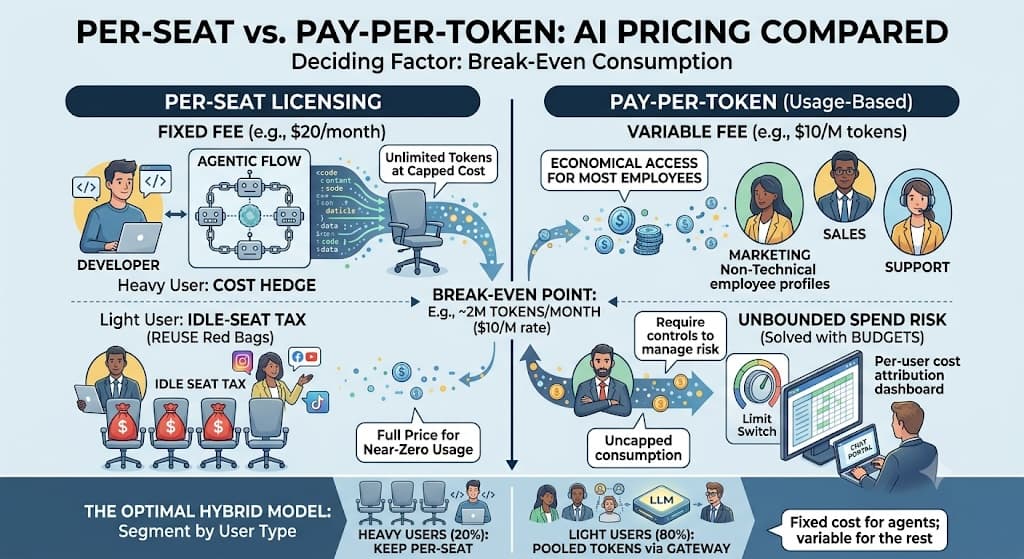
Per-seat pricing charges a fixed recurring fee for each user with access, regardless of how much they use the product. It is the standard SaaS model: $20–60 per user per month is typical for enterprise AI tools in 2026, usually with seat minimums and annual commitments. Cost is a function of headcount.
Usage-based (pay-per-token) pricing charges for actual consumption — the tokens processed on each request, billed at published per-million rates that vary by model. Access itself is free; you pay when work happens. Cost is a function of activity.
The distinction that matters is not really "fixed versus variable." It is what your bill is coupled to. Per-seat couples cost to how many people you employ. Usage-based couples it to how much work AI actually does. Which one you want depends entirely on whether those two numbers move together in your organization — and in most companies, they emphatically do not.
Side by Side
| Per-Seat | Pay-Per-Token | |
|---|---|---|
| Bill scales with | Headcount | Actual usage |
| Light users cost | Full price | Near zero |
| Heavy users cost | Same as light users | Proportional to consumption |
| Predictability | High — known in advance | Variable unless capped |
| Cost ceiling | Contractual | Whatever you enforce |
| Provider choice | Locked per contract | Switch or mix freely |
| Usage visibility | Typically login-level | Per request, per user, per model |
| Procurement effort | One negotiation, annual | Ongoing monitoring |
| Fails when | Utilization is low | Consumption is ungoverned |
Neither column is universally better. The last row is the one to read twice: each model has a specific failure mode, and choosing well is mostly about knowing which failure you are more exposed to.
Where the Break-Even Actually Sits
This is the question the comparison charts usually skip, and it is the only one that produces a decision.
Break-even is the monthly consumption level at which a user's tokens cost the same as their seat. Below it, usage-based is cheaper; above it, the seat is a bargain.
Blended token rates vary widely by model — efficient models run well under a dollar per million tokens, frontier models run many times higher. Using a mid-range blended rate of roughly $10 per million tokens as a working assumption:
| Seat price / month | Break-even usage |
|---|---|
| $20 | ~2.0M tokens/month |
| $30 | ~3.0M tokens/month |
| $40 | ~4.0M tokens/month |
| $60 | ~6.0M tokens/month |
Abstract numbers, so translate them. A substantive chat exchange — prompt, context, and response — typically runs somewhere around 1,000–2,000 tokens. At that rate, 2 million tokens a month is roughly 1,000–2,000 exchanges, or 50–100 every working day, every day.
That is the honest test. Ask whether a given employee plausibly has 50–100 real AI interactions daily. For a support agent drafting replies all shift, maybe. For a developer running agents across a codebase, easily — agentic workloads blow past these thresholds without trying, because a single task can chain dozens of model calls. For a marketing manager, a sales rep, a finance analyst, or an HR partner, it is not close.
Two conclusions follow, and they are the whole argument:
- For most non-technical employees, usage-based pricing is dramatically cheaper — often by an order of magnitude, because their real consumption sits far below break-even.
- For agentic and developer workloads, per-seat pricing can be a genuine bargain — a flat fee that caps what would otherwise be a very large token bill.
Your blended rate will differ from the assumption above; run the same arithmetic with your own numbers, or use the AI cost savings calculator to model it against your headcount.
Model Your Own Break-Even
Book a demo of SecuriX and we'll run your actual headcount and usage against both pricing models.
When Per-Seat Genuinely Wins
Any comparison that concludes "usage-based always wins" is selling something. Per-seat is the better choice when:
Usage is consistently above break-even. If your users really do consume millions of tokens monthly, a flat fee is a hedge — you have effectively bought unlimited usage at a capped price.
Agentic workloads dominate. Coding agents, research agents, and automated pipelines consume tokens at rates human chat never approaches. Where a vendor offers those capabilities on a flat seat, that seat is frequently underpriced relative to the compute behind it.
Budget predictability outranks total cost. Some finance organizations will pay a premium for a number that does not move. A known $180,000 can be easier to defend than a forecast averaging $90,000 with variance.
The product is more than model access. Seat prices often bundle a polished interface, integrations, support, and compliance paperwork. If you would otherwise build or buy those separately, comparing seat price to raw token cost is not comparing like with like.
You lack the controls to govern usage. This one is important and self-aware: usage-based pricing without budgets, throttling, or attribution is a genuine risk. If you cannot enforce limits, a fixed seat price is the safer purchase — right up until you can.
When Usage-Based Wins
Utilization is uneven. The near-universal case. When roughly 20% of employees drive 80% of consumption, per-seat pricing makes the 80% subsidize the 20%. Usage-based bills each group for what it actually does.
You want broad access. Because light users cost almost nothing, usage-based pricing lets you extend AI to the entire company — including teams that would never have justified a seat. Access stops being a budget decision. We covered this pattern in detail for AI for non-technical teams.
You want provider flexibility. Token-based access means the model is a configuration choice rather than a contract. Route teams to different providers, adopt a cheaper model the week it ships, and avoid annual lock-in.
You need attribution. Usage-based billing produces per-user, per-team, per-model data as a byproduct. That enables chargeback and informed optimization — visibility a seat invoice structurally cannot provide.
The Hidden Costs Nobody Quotes
Per-seat: the idle-seat tax. The gap between seats bought and seats used is invisible on an invoice that shows only the total. Vendor admin panels usually reveal login-level utilization, and the numbers are typically sobering.
Per-seat: minimums and true-ups. Seat floors mean small teams pay for capacity they do not have. Mid-term additions often price at list rather than your negotiated rate, and seat counts are usually far easier to increase than decrease.
Per-seat: the shadow AI it produces. When seats are rationed to control cost, the employees without one do not stop using AI — they use personal accounts. You end up paying for both, and only one of them is visible.
Usage-based: unbounded spend. The real risk, and the one per-seat advocates correctly raise. A retry loop, a stuck agent, or an enthusiastic new user can consume a month's budget quickly. This is solvable — team budgets with hard enforcement at the gateway make the ceiling physical rather than advisory — but it is not solved by default.
Usage-based: attribution overhead. Raw provider invoices tell you a total, not who spent it. Without per-user and per-team cost attribution, you have traded one opaque number for another.
The Hybrid Most Companies Land On
In practice, the answer for a company of any size is rarely one model for everyone. The pattern that keeps recurring:
- Developers and heavy agentic users stay on per-seat tools where the flat fee is genuinely favorable for their consumption.
- Everyone else — the other 70–80% of headcount — moves to pooled pay-per-token access through a shared gateway, with a chat portal behind SSO.
This works because it applies each model where its economics are actually favorable, rather than forcing one across a workforce with wildly different usage profiles. The developer tools keep earning their seats; the light-usage majority stops paying power-user rates. Most of the savings show up immediately, because that majority is where the waste was concentrated.
The AI cost optimization overview covers the pooled side.
How to Decide
Four questions, in order:
- What is your real utilization? Pull login and usage data from your current vendor admin panel before modeling anything. This number alone often decides it.
- Where does your usage sit relative to break-even? Estimate monthly tokens per user against the table above. Segment by team — the answer will differ sharply between engineering and everyone else.
- Can you enforce limits? If yes, usage-based risk is manageable. If not, either acquire that capability or stay on seats until you can.
- What are you actually buying? If the seat price includes an interface, integrations, and compliance you would otherwise build, count that in the comparison.
If the arithmetic is close, favor the model that produces better data. Usage-based pricing generates the attribution you need to optimize further; per-seat pricing gives you a number and nothing else.
Frequently Asked Questions
Which is cheaper, per-seat or pay-per-token AI pricing? For most organizations, pay-per-token is substantially cheaper — typically 60–80% less — because the majority of employees consume far below the break-even point where a seat pays for itself. The exception is heavy agentic and developer workloads, where a flat seat fee can be favorable.
What is the break-even point between the two models? At a mid-range blended rate of roughly $10 per million tokens, a $20 seat breaks even at about 2 million tokens per month, and a $60 seat at about 6 million. In practical terms that is 50–100 substantive AI exchanges every working day — a level most non-technical employees do not approach.
Isn't usage-based pricing unpredictable? Only without controls. When budgets are enforced at the gateway, spend physically cannot exceed the limits you set — which is arguably more control than a per-seat contract, where the cost is fixed but the utilization is unknown.
Can we use both models at once? Yes, and most companies should. Keep per-seat developer tools where the consumption justifies them, and move the light-usage majority to pooled token-based access.
How do we move from per-seat to usage-based? Deploy a gateway alongside your existing licenses, migrate teams as their needs are met, and let seat contracts lapse at renewal rather than breaking them mid-term. The complete guide to AI cost optimization includes a 30-day rollout plan.
The Bottom Line
Per-seat and usage-based pricing are not better or worse in the abstract — they are bets on different things. Per-seat bets that your users will consume enough to justify the fee. Usage-based bets that you can govern consumption well enough to keep it efficient.
For a small population of heavy and agentic users, the first bet pays off. For the large majority of employees in a typical organization, it does not, and it has not for some time. The arithmetic is not subtle: run your own numbers on real utilization, segment by team, and you will usually find the answer is both — per-seat where consumption earns it, pooled tokens everywhere else.
SecuriX provides the pooled side: one gateway, pay-per-token billing, team budgets with hard enforcement, per-user cost attribution, and an SSO chat portal for everyone who does not need a seat.
Book a Demo
See the pooled model in action — budgets, attribution, and a chat portal your whole company can use.
Related reading: AI Cost Optimization: The Complete Guide for 2026 · AI for Non-Technical Teams Without Per-Seat Licenses · Cut Enterprise AI Costs in Half
— The SecuriX Team
Community Forum
Questions, Feedback & Discussions
Join the conversation
Recent Discussions 0 Comments
No questions yet. Be the first!